Call (855) 551-2628 Get Transport Quote
Boat Toronto
  • Instagram
  • Home
  • About
  • Boat Transportation
  • Other Services
    • Storage
    • Winterization / Shrink Wrap
    • Maintenance / Repairs
  • Gallery
  • Reviews
  • GET TRANSPORT QUOTE
  • Search
  • Menu Menu

Tag Archive for: Boat Storage Toronto

Boat Storage, Boat Storage & Transport, Toronto Boat Storage

Boat Trailer Storage Toronto: Secure Indoor Options

Boat trailer in secure fenced storage yard with canopy and shrink-wrapped boat

Table of Contents

  • Boat Trailer Storage in Toronto: Secure and Affordable Options
  • Storage Options for Boat Trailers in the Greater Toronto Area
  • Monthly Rates and Services for Boat Trailer Storage
  • Licensing and Security for Boat Trailer Storage in Toronto
  • Reserve Your Boat Trailer Storage at Boat Toronto
  • Your Partner for Boat Trailer Storage in Toronto

Boat Trailer Storage in Toronto: Secure and Affordable Options

Beyond storing your boat, we also provide secure and affordable boat trailer storage in Toronto, with flexible options to fit your needs.

We offer both indoor boat storage at our main facility and outdoor storage in our secure boat yard north of Milton. All storage areas feature 24/7 surveillance and controlled access, so you have peace of mind knowing your trailer is safe. We keep our rates competitive and provide a free custom quote to match your specific needs. When you store your trailer with us, we can also winterize your boat—just ask about our combined storage and winterization packages. For seamless seasonal care, we also offer professional boat winterization in Toronto to protect your vessel while the trailer is stored. Our boat trailer storage in Toronto keeps your trailer safe and ready for next season.

Call or Text us for more information and to get your free quote.

Storage Options for Boat Trailers in the Greater Toronto Area

Once your trailer is safely transported, you’ll need a reliable option for boat trailer storage Toronto. We provide both on-site storage at our Toronto facility and off-site storage north of Milton, giving you flexible choices tailored to your needs. The comparison below highlights the differences so you can make an informed decision.

On-Site vs. Off-Site Storage: What Boat Toronto Offers
FeatureOn-Site (Toronto)Off-Site (North of Milton)
Security24/7 monitored, fenced yard with gated accessNot specified; farm-storage environment with limited surveillance
AccessibilityAppointment-based access near downtown TorontoTypically self-serve, less flexible hours
Pricing (monthly)Competitive market rates; call for quoteOften lower per month due to remote location
CapacityLimited yard space; indoor slots availableLarge open yard, usually more availability
Winterization SupportOn-site winterization and shrink-wrap packages availableMust arrange separately or do yourself

Our on-site facility combines a secure boat yard in Toronto with convenient appointment-based access. You’ll enjoy 24/7 monitored security and the option of indoor boat storage in Toronto — a valuable protection against Ontario’s harsh winters. If you need a space for the whole off-season, our experienced team handles winterization and shrink-wrapping on-site.

Feature comparison matrix: On-Site vs Off-Site storage options for boat trailers in the Greater Toronto Area

Side-by-side comparison of on-site and off-site boat storage

For boat trailer storage Toronto, we believe on-site storage provides the best security and convenience. Off-site storage north of Milton may offer lower monthly rates and a larger open yard, but it lacks the dedicated security and integrated winterization support we provide. For many GTA boat owners, the peace of mind of a centrally located, fully serviced facility is well worth the competitive pricing. We can also arrange transport to move your trailer into our yard, ensuring a seamless experience from haul-out to storage.

For responsible boating, we recommend completing Canadian boating safety courses from CanBoat — a great way to stay safe on the water. Depending on your storage choice, we can also arrange winterization and maintenance. Call or Text us for more information about our storage options and current rates.

Monthly Rates and Services for Boat Trailer Storage

Now that you know the benefits of boat trailer storage, let’s explore our monthly rates and services. When searching for reliable boat trailer storage in Toronto, our facility offers competitive monthly rates that scale with your trailer size and your choice between indoor boat storage and a secure outdoor unit. We strive to provide affordable, flexible plans that accommodate everything from compact single-axle trailers to larger tandem-axle setups without locking you into rigid long-term contracts.

Every storage plan includes 24/7 security monitoring and controlled access so you can retrieve your trailer on a schedule that suits you. Arrange pick-up at your convenience with flexible access hours built around the boating season. Our primary secure boat yard serves the Greater Toronto Area, and we extend capacity to an off-site indoor storage location north of Milton for clients who need extra space or longer-term protection from the elements.

For added convenience, we also provide resources to help with your pleasure craft licence renewal and required documents. Our team has compiled the documentation checklists and step-by-step guidance you need to keep your vessel compliant, whether you’re applying for the first time or updating an existing licence. Contact us for a free custom quote tailored to your trailer, or call or text us for more information about current availability. Looking to combine storage with winterization? We offer discounts on bundled services.

Licensing and Security for Boat Trailer Storage in Toronto

When seeking boat trailer storage in Toronto, licensing and security should be top priorities. At Boat Toronto, we offer licensed and secure storage options that meet regulatory requirements and protect your vessel.

A valid pleasure craft licence is essential for storing your boat at our facility—it confirms you are compliant with federal regulations. Transport Canada’s 2026 updates are modernizing the process, and we encourage you to check our FAQ for the latest requirements. We also recommend winterization: follow our checklist to protect your engine and plumbing from freezing.

Our indoor boat storage and secure boat yard are protected by 24/7 monitoring, controlled access, and surveillance cameras. All entry points are secured by electronic gates, and only authorized personnel have access after hours. Our team regularly patrols the premises to ensure everything remains in order. We provide flexible options, from climate-controlled indoor spaces to our monitored outdoor yard. All our sites are conveniently located, enabling quick transport when you’re ready to hit the water. This delivers safe and efficient storage, keeping your boat protected and accessible.

Reserve Your Boat Trailer Storage at Boat Toronto

When you need reliable boat trailer storage in Toronto, Boat Toronto makes it simple. Now that you’ve seen our services, reserving your spot is the natural next step.

  • 24/7 Secured Storage: Choose our indoor boat storage in Toronto for complete weather protection or our secure boat yard in Toronto for convenient open-air layup, both monitored around the clock.
  • Flexible Terms and Competitive Pricing: We offer short-term and seasonal options tailored to your schedule, with rates that respect your budget.
  • Full-Service Convenience: Beyond parking your trailer, we provide winterization and maintenance, making launch day effortless.

Our comprehensive winterization approach, explained in our FAQ, starts with secure storage, and our specialists handle every detail. Spots fill quickly as the season approaches, so we recommend reaching out early to secure your boat trailer storage in Toronto. We’re here to help. Call or text us for a free custom quote and to reserve your boat trailer storage today.

Your Partner for Boat Trailer Storage in Toronto

When you need reliable boat trailer storage in Toronto, turn to the local experts at Boat Toronto Inc. We understand the unique demands of the boating community across the GTA and the Lake Ontario shoreline.

Our facility offers both indoor boat storage and a protected outdoor lot—a truly secure boat yard with 24/7 monitoring and flexible access hours.

Call or text us today for a free custom quote and discover why we’re one of the most reliable storage solutions in Toronto.

Resources

  • Get Your PCOC Certification with Canada’s Official Course
August 25, 2026/by Lukas A
https://boattoronto.ca/wp-content/uploads/2026/08/featured-77af8386-9814-4ad5-99a3-c25dc8db0aa6.jpg 768 1408 Lukas A /wp-content/uploads/2024/05/logo-300x138.png Lukas A2026-08-25 00:50:352026-08-25 00:50:35Boat Trailer Storage Toronto: Secure Indoor Options
Boat Storage & Maintenance, Boat Transport & Logistics, Boating Regulations & Safety, Boating Resources & Guides, Greater Toronto Area Marine Services, Marine Services Ontario

Professional Boat Hauling vs DIY Towing: Key Cost Risks

Split-screen comparison of professional boat hauling versus DIY towing on Ontario highway

Table of Contents

  • Evaluating Professional Boat Hauling vs DIY Towing in Ontario
  • Boat Hauling Options Across Ontario
  • Availability of Professional Boat Hauling Services in Ontario
  • Local Regulations and Equipment Considerations for Boat Towing in Ontario
  • Making Your Decision on Professional vs DIY Boat Hauling
  • Choosing the Right Boat Transport Method for Your Needs

Evaluating Professional Boat Hauling vs DIY Towing in Ontario

Evaluating professional boat hauling vs DIY towing in Ontario starts with understanding the true boat hauling cost. While many owners consider towing their boat themselves, hidden expenses and complex regulations make professional transport the smarter choice. Our transparent per-mile pricing eliminates guesswork, unlike the unpredictable fuel, permit, and damage risks of DIY. For boats over 2.6 metres wide, DIY towing requires oversized boat transport permits in Ontario—renewed each trip—while we handle all paperwork and carry marine transit insurance coverage that standard auto policies lack. Our Conolift hydraulic trailers and door-to-door service save you from owning a tow vehicle and specialized gear. For boats over 20 feet or long hauls, professional hauling is safer and more reliable—request a free custom quote for complete cost clarity.

Boat Hauling Options Across Ontario

Once you understand why safe and efficient transportation is essential, the next decision is how to move your vessel. The choice often boils down to professional boat hauling vs diy towing, especially for boats over 22 feet. In Ontario, you must secure an oversize vehicle permit in Ontario before moving a large boat—something professional haulers handle as part of their service. DIY owners, however, face the challenge of managing oversized boat transport permits in Ontario on their own, along with verifying that marine transit insurance coverage is in place, as standard auto or boat policies rarely cover in-transit damage.

The table below breaks down the key differences across permits, equipment, insurance, cost, risk, and suitability to help you decide which option fits your situation.

Area Comparison: Professional Hauling vs DIY Towing in Ontario

AspectProfessional Boat HaulingDIY Towing
Permit ComplexityHauler obtains all required oversize permits (MTO) and ensures compliance with route restrictions.Owner must research and apply for permits independently; risk of fines for missing or incorrect permits.
Equipment NeededSpecialized Conolift hydraulic trailer, custom tie-downs, and support braces for vessels up to 50 ft.Standard boat trailer (often inadequate for large boats), tow vehicle with sufficient capacity, additional safety equipment.
Insurance CoverageMarine transit insurance covers hull damage, road debris, and liability during transport.Standard auto or boat insurance may not cover in-transit damage; separate policy needed.
Cost Estimate (per km)Typically $3–$6 per km for long-distance; includes permits, insurance, and equipment.Variable: fuel, trailer rental, permit fees ($200–$500+), insurance upgrade; may be cheaper for short trips.
Risk LevelLow – trained operators, route planning, and insurance mitigate most risks.High – especially for large boats, long distances, or unfamiliar routes; risk of accidents, fines, and damage.
Best ForVessels over 22 ft, long-distance moves, cross-border transport, owners seeking peace of mind.Small boats (under 22 ft), short local moves, owners with towing experience and proper equipment.

For vessels over 22 feet, professional hauling almost always proves safer and more cost-effective due to included permits and insurance, lowering your overall risk. Peace of mind comes from knowing your boat is handled by trained operators using the right equipment.

Comparison infographic showing professional boat hauling with green icons and DIY towing with orange warning icons

Professional boat hauling versus DIY towing comparison

For the most reliable boat transport, storage, and repairs, professional hauling is the clear choice for larger vessels and long hauls. Call or Text us for more information or to get your free custom quote today.

Availability of Professional Boat Hauling Services in Ontario

Professional boat hauling services are readily available throughout Ontario, with licensed, insured providers offering safe and efficient transportation for vessels up to 50 feet. While some boat owners attempt DIY towing, the risks of lacking specialized equipment, missing oversize permits, and having no marine transit insurance coverage often make professional transport the smarter investment. Boat Toronto Inc. provides comprehensive coverage across the province, from Toronto and the GTA to Barrie, Owen Sound, and cross-border routes into the United States.

Our boat transport in Toronto services cover everything from local marina moves to long-distance hauls, using a Conolift hydraulic trailer designed for boats up to 50 feet. Unlike do-it-yourself towing, we manage all oversized boat transport permits in Ontario, ensuring full legal compliance. Every move includes marine transit insurance coverage, so you’re protected against liability. As the most reliable boat transport provider, we offer flexible scheduling and a free custom quote tailored to your specific journey.

Choosing professional hauling means your vessel benefits from expert handling, specialized equipment, and dedicated route planning. We also provide storage, and repairs to keep your boat in top condition. We make the process straightforward—simply contact us for a free custom quote and experience safe and efficient transportation for your boat. Call or Text us for more information.

Local Regulations and Equipment Considerations for Boat Towing in Ontario

When weighing professional boat hauling vs DIY towing in Ontario, understanding local regulations is essential. Any boat trailer on public roads must display a permit and license plate. Trailers over 2,800 kg require electric brakes; those wider than 2.6 m or above weight thresholds demand an oversized vehicle permit from the MTO. All motorized vessels need a current pleasure craft licence, renewable online through Transport Canada.

Beyond legal paperwork, proper equipment is crucial for safe towing. Trailers must have fully functional lighting, safety chains, and a breakaway system to prevent runaway incidents. For wider loads, securing oversized boat transport permits in Ontario is mandatory, and adequate marine transit insurance coverage protects against damage during transport. Professional haulers like BoatToronto work to meet these requirements, reducing personal liability.

When weighing the effort of DIY compliance against professional service, many Ontario boat owners choose the latter. According to BoatToronto.ca’s guide on pleasure craft licence renewal, keeping documents current is simple with professional help. For peace of mind, checking reliable boat transport carriers reviews helps you find a compliant provider. We believe the most reliable boat transport services eliminate regulatory guesswork, making professional hauling the safer choice.

Making Your Decision on Professional vs DIY Boat Hauling

Deciding between professional boat hauling vs diy towing often comes down to distance, boat size, and the hidden complexities of transport regulations. For owners in the Greater Toronto Area, understanding the true costs and risks is essential to choosing wisely.

Boats wider than 8.5 feet require oversized boat transport permits in Ontario — a requirement we handle for you. When you tow yourself, you must secure these permits, purchase specialized marine transit insurance coverage, and ensure your trailer and vehicle can handle the load. Beyond obvious fuel and rental expenses, a DIY tow can also void manufacturer warranties if not performed correctly. In contrast, our professional service includes permits, licensed insurance, and our Conolift hydraulic trailer, which safely handles vessels up to 50 feet. According to our 2026 cost data, professional hauling rates for long-distance trips ($2.00–$3.50 per mile) often compete with the total cost of a DIY trip once permits, insurance, and time are factored in.

  • Professional Hauling: Handles oversized permits, includes marine transit insurance, uses specialized Conolift equipment, and saves you time.
  • DIY Towing: May save money on very short trips if you already own a suitable trailer, but hidden costs can add up quickly.

For safe and efficient transportation, request a free custom quote — call or text us today.

Choosing the Right Boat Transport Method for Your Needs

  • Boats over 20 ft require professional transport for oversized boat transport permits in Ontario compliance.
  • DIY towing requires permits, equipment, and liability; our team provides marine transit insurance coverage and licensed drivers.
  • Cost: DIY adds fuel and equipment fees; our competitive per-mile rates include a free custom quote.

Get the most reliable boat transport with a free custom quote today.

Resources

  • Access Ontario Government Services and Information
August 7, 2026/by Lukas A
https://boattoronto.ca/wp-content/uploads/2026/08/featured-65a913eb-4065-471c-b808-2b815b48eda0.jpg 768 1408 Lukas A /wp-content/uploads/2024/05/logo-300x138.png Lukas A2026-08-07 00:38:122026-08-07 00:38:12Professional Boat Hauling vs DIY Towing: Key Cost Risks
Boat Ownership & Maintenance, Boat Storage & Transport, Boating Laws & Regulations, Marine Services, Ontario Boating Guide, Transport Canada Updates

2026 Transport Canada Boating License Updates: Complete Guide

Boater on Ontario lake holding a pleasure craft licence document, smiling, with motorboat and sunny background

Table of Contents

  • 2026 Transport Canada Boating Licence Updates in Ontario
  • Pleasure Craft Licence Renewal: Transition to Five-Year Cycles
  • Fees, Fines, and Penalties Under the 2026 Rules
    • New Fee Structure for 2026
    • Penalties for Non-Compliance
      • PCOC Penalties in Ontario
      • Unlicensed Operation and Oversize Transport Fines
  • Step-by-Step Guide to Renewing Your Boat Licence
    • How to Renew Your Pleasure Craft Licence Online
    • Setting Up Renewal Reminders and Maintaining Records
  • Ownership Transfers, Exemptions, and Special Cases
  • Frequently Asked Questions About the 2026 Licence Updates
  • Staying Compliant with Transport Canada’s 2026 Requirements

2026 Transport Canada Boating Licence Updates in Ontario

Beyond registration and safety gear, keeping your boating licence current is equally important. The 2026 Transport Canada boating licence updates introduce a mandatory 5-year renewal cycle for pleasure craft licences in Ontario.

Boaters can now complete the entire renewal online through the Transport Canada website, a process that takes less than 15 minutes and provides an immediate digital receipt. The 5-year renewal cycle for pleasure craft licences aligns with Transport Canada’s updated regulations, and a $5 pleasure craft licence renewal fee applies. To renew your pleasure craft licence in Ontario, visit the official portal and have your licence number and identification ready.

Boaters must verify that their name, address, and email are current with Transport Canada to avoid processing delays. Boat Toronto’s FAQ provides step-by-step instructions for Ontario boaters and links to the renewal portal. The 2026 updates apply to all new applications and renewals from that date forward; existing licences remain valid until their normal expiry date, but we recommend renewing early to avoid any lapse in coverage. Operating a vessel without a valid pleasure craft licence could result in fines starting at $250. With your licence in order, you can focus on preparing your boat for the season. At Boat Toronto, we offer safe and efficient transportation, storage, and repairs to keep your vessel in top shape.

Pleasure Craft Licence Renewal: Transition to Five-Year Cycles

The 2026 Transport Canada boating license updates introduce a fundamental shift for Canadian boaters, moving from lifetime pleasure craft licences to a mandatory five-year renewal cycle. The new rules, set to take effect in 2026, aim to keep vessel and owner information current while generating a modest recurring fee to support the licensing system. For the most authoritative details, refer to the Transport Canada pleasure craft licence updates page, where official regulations and step-by-step guidance are published.

The following table highlights the key differences between the old and new systems.

Lifetime Licence vs Five-Year Renewal (2026)
AspectOld System (Pre-2026)New System (2026)
Licence ValidityLifetime – no renewal requiredFive-year renewable term
Initial CostOne-time fee (varies); no recurring chargeService fee every five years (starting at $24)
Record UpdatesOwner info rarely updatedMandatory updates at each renewal

The most visible change is the shift from a permanent licence to a five-year term. Under the pleasure craft licence 5 year renewal framework, owners must now track expiration dates and submit a renewal application every five years to keep their licence valid. This recurring requirement replaces the one-time licence previously issued for the vessel’s lifetime. The new pleasure craft licence renewal fee starts at $24 and will be charged at each renewal interval, according to Transport Canada’s updated schedule. While the fee is modest, boaters should budget for it every five years rather than treating licensing as a single-transaction event.

Equally important is the emphasis on record accuracy. Transport Canada now requires owners to provide current contact information at each renewal. As noted by Boat Toronto in their licensing FAQ, maintaining up-to-date details helps avoid potential fines and ensures that authorities can reach vessel owners quickly. Outdated addresses or phone numbers can delay important safety recall notices or compliance communications, so the five-year cycle serves as a built-in prompt to review and verify your information.

Comparison infographic showing old lifetime pleasure craft licence system versus new five-year renewable system with fee details

Lifetime vs five-year pleasure craft licence comparison

When it comes time to renew, the primary channel is the Transport Canada online portal. According to Transport Canada, the online renewal process typically takes less than 15 minutes and provides an immediate digital receipt. Some marine service providers, including Boat Toronto, offer informational guidance and FAQs to help boaters navigate the steps, though the actual renewal must be completed through the official website or by mail. We at Boat Toronto encourage boaters to stay informed about these changes and to bookmark the Transport Canada page so they can easily access the renewal form when their term expires. Staying compliant with your licence supports safe and efficient transportation on the water and helps you avoid penalties. Set a calendar reminder for your five-year mark and make the renewal part of your regular boat-ownership routine.

Fees, Fines, and Penalties Under the 2026 Rules

With the 2026 Transport Canada boating license updates, Ontario boaters now face a revised fee structure and clearer penalty frameworks. The changes introduce a new $24 CAD renewal service charge and reinforce enforcement for unlicensed operation, PCOC non-compliance, and oversize transport. We break down the key costs and consequences as they stand under the updated federal and provincial rules.

New Fee Structure for 2026

A central component of the 2026 updates is the introduction of a $24 CAD service fee for pleasure craft licence renewals. This charge applies every five years and is payable online through the Transport Canada portal. According to Transport Canada, the fee covers processing costs and may be adjusted annually for inflation—so the exact amount could shift with future economic conditions. The $24 pleasure craft licence renewal fee is a service charge, meaning your pleasure craft licence 5 year renewal now includes this non-taxable processing cost, separate from any other administrative fees.

The following table consolidates the most common fees and fines Ontario boaters should expect under the 2026 regulatory framework, drawing on official Transport Canada schedules and internal industry knowledge from Boat Toronto.

2026 Licensing and Penalty Fees Overview
ItemAmount (CAD)Details
Pleasure Craft Licence Renewal Fee$24Service fee for online renewal every five years
Ownership Transfer FeeTBD (processing fee applies)Covers record updates and new licence issuance
Fine – No Valid PCOCUp to $250Provincial enforcement; may increase under 2026 rules
Fine – Unlicensed OperationUp to $500+ per offenceDepends on jurisdiction and vessel class
Oversize Transport Without PermitVaries (typical $200–$600)Plus potential impoundment; relevant for boat hauling

While the ownership transfer fee remains to be determined, the provisional figures show that compliance remains far more affordable than the financial and operational risks of non-compliance.

Penalties for Non-Compliance

The 2026 regulatory updates not only set new costs but also reinforce existing penalties, making it essential for boaters to stay fully compliant. Authorities in Ontario actively enforce these rules, and violations can lead to fines, administrative penalties, and even vessel impoundment.

PCOC Penalties in Ontario

In Ontario, operating a powered watercraft without a valid Pleasure Craft Operator Card (PCOC) can result in a fine of up to $250 CAD per offence. Provincial enforcement officers may issue tickets on the spot, and the 2026 rules leave room for increased penalties in the future. Transport Canada mandates that all operators carry their PCOC while underway, and our local experience confirms that even first-time infractions can trigger the maximum fine if the situation warrants. We strongly recommend keeping your card accessible and renewed.

Unlicensed Operation and Oversize Transport Fines

Operating a vessel without a valid pleasure craft licence is a separate offence that can carry fines exceeding $500 CAD per incident, depending on the vessel class and jurisdiction. For those transporting larger boats, failing to obtain an oversize permit in Ontario also triggers significant penalties. According to our own service data and industry guidelines, typical fines for unpermitted oversize loads range from $200 to $600 CAD, and the transport vehicle may be impounded until proper permits are secured. We are the most reliable boat transport provider for oversize vessels in Ontario, and we always emphasize that securing the correct permits is not a formality—it is a legal requirement that protects your investment and your record.

Staying on top of these updated fees and penalties will keep your boating season trouble-free. Beyond licensing compliance, keep your vessel in top shape year-round with our detailed boat winterization checklist for outboard motors.

Step-by-Step Guide to Renewing Your Boat Licence

With the 2026 Transport Canada boating license updates, renewing your pleasure craft licence has never been more straightforward. We’ll walk you through the online process, outline all available methods, and help you stay organised for seasonal maintenance and transport.

How to Renew Your Pleasure Craft Licence Online

Your pleasure craft licence requires a 5 year renewal, and the online portal makes it quick and hassle-free. Follow these steps:

  1. Access the Transport Canada portal and log in using your current licence number and personal identification details. This ensures that only verified owners can initiate the renewal.
  2. Verify your vessel details. Confirm that the hull identification number, length, and other specifications are still accurate. If any information has changed, update it before proceeding.
  3. Upload proof of ownership. Acceptable documents include a signed bill of sale or a builder’s certificate. Ensure the scan or photo is clear and legible.
  4. Pay the $24 fee by credit card. The pleasure craft licence renewal fee is the same regardless of method and is valid for five years. Once payment is submitted, you’ll receive an instant digital confirmation.
  5. Download and save the confirmation PDF. This document serves as your temporary proof of licence until the updated card arrives.

The entire online process typically takes less than 15 minutes and provides immediate proof of renewal. We recommend renewing well before your current licence expires to avoid any disruption in coverage.

Here’s how the three renewal methods compare under the 2026 rules:

Renewal Options: Online vs Paper vs In-Person
MethodProcessing TimeDocumentation NeededIs It Recommended?
Online (Transport Canada Portal)Same day – instant confirmationProof of ownership, current licence number, $24 feeYes – fastest and most reliable
Mail (Paper Form)2–4 weeksForm 84-0003, proof of ownership, cheque/money orderUse only if no internet access
In-Person at Service CanadaVaries by locationSame as mail plus photo IDPossible but less convenient

Under the 2026 rules, the online system is the clear winner for speed and convenience. Transport Canada and Boat Toronto both advise using the portal because it eliminates mailing delays and gives you immediate verification that you’re compliant. While mail and in-person options remain available, they are best reserved for those without reliable internet access.

Once your licence is renewed, staying on top of future renewals and keeping your paperwork organized will make seasonal upkeep much smoother.

Setting Up Renewal Reminders and Maintaining Records

Proactively managing your licence renewal prevents last-minute scrambles. We recommend setting a recurring digital or paper calendar reminder six months before your next expiry date—this buffer gives you plenty of time to gather documents and avoid a lapse.

After you receive your updated pleasure craft licence, store the physical card in a waterproof document holder kept on board. Equally important is keeping a digital copy securely backed up. We suggest saving it alongside your boat winterization checklist for easy reference during storage and transport planning. A complete record set—licence, insurance, and winterization log—streamlines everything from haul-out to spring launch.

To build that log, Boat Toronto’s essential winterization checklist covers engine flushing, fuel stabilization, battery maintenance, and shrink-wrapping. The outboard motor winterization steps, such as flushing for 15 minutes and fogging cylinders, are detailed in our resources and help ensure your vessel remains in top condition while in storage. Keeping these records together means any service provider can instantly verify your boat’s history.

By staying organized now, you’ll simplify future transport, winterization, and repairs. For seamless boat care, Boat Toronto provides expert assistance with winterization, storage, and safe and efficient transportation. Contact us for a free custom quote and let our licensed team handle the rest.

Ownership Transfers, Exemptions, and Special Cases

Beyond initial licensing, current owners must also manage ownership transfers under the updated regulations. Under the 2026 Transport Canada boating license updates, the process is now more transparent and follows a clear three-step structure, as shown below.

Ownership Transfer Requirements (2026)
StepActionTimelineCost
1 – Obtain Bill of SaleSeller provides signed bill of sale with vessel detailsWithin 30 days of saleNo fee for document
2 – Submit Transfer ApplicationBuyer submits application to Transport CanadaWithin 30 days of receiving billProcessing fee (TBD)
3 – Receive Updated LicenceTransport Canada issues new pleasure craft licence in buyer’s name2–6 weeksIncluded in processing fee

As Step 1 indicates, the seller must supply a signed bill of sale that includes hull identification and other vessel particulars within 30 days of the sale. We recommend obtaining this document immediately to avoid delays. According to Transport Canada, the buyer must submit the transfer application no later than 30 days after receiving the bill. The processing fee, which is still to be finalized by Transport Canada, is separate from the pleasure craft licence renewal fee that applies later in the cycle. Once the application is complete, Transport Canada typically mails the updated licence to the buyer within two to six weeks. After the transfer, the new owner’s pleasure craft licence continues to be valid for the remainder of the original 5-year renewal cycle.

The 2026 Transport Canada boating license updates also clarify which vessels are exempt from licensing altogether. Exempt vessels have no transfer obligation:

  • Vessels under 3 metres that are not permanently fitted with a motor
  • Non-powered craft such as rowboats, canoes, and kayaks
  • Vessels used exclusively for racing with a valid race permit

For unlicensed pleasure craft, only a bill of sale is needed to document ownership; no transfer application is required.

Special circumstances have their own requirements:

  • Inheritance – The transfer must be documented with a probate letter or a copy of the will.
  • Corporate ownership – Only a change of the registered owner (the corporation) triggers a transfer; internal beneficial-owner changes do not.
  • Change of address – The owner must notify Transport Canada of a new address, but a full transfer is not necessary.

Understanding these transfer and exemption rules is the first step toward staying compliant with federal regulations. Failing to transfer a licence within the required timeframe can lead to administrative penalties or complications with mooring and insurance. Next, we’ll cover what happens if requirements are not met.

Frequently Asked Questions About the 2026 Licence Updates

The following FAQs address common questions about the 2026 Transport Canada boating license updates, including the renewal process and fees.

How do I renew my pleasure craft licence for 2026?
According to our renewal guide, renew online via Transport Canada in under 15 minutes from home or office with your licence number and ID. You get a digital receipt immediately. Mail-in and in-person Service Canada renewals are also available, but may take longer.

What is the renewal fee for a pleasure craft licence?
Transport Canada mandates a $5 pleasure craft licence renewal fee for the 5-year term. The pleasure craft licence 5 year renewal amount is subject to change without notice, so check the official site.

Staying Compliant with Transport Canada’s 2026 Requirements

The 2026 Transport Canada boating licence updates introduce a new 5-year renewal cycle for pleasure craft licences in Canada, ending indefinite validity. Boaters must now renew every five years.

The pleasure craft licence 5 year renewal process is completed online through Transport Canada’s boating safety portal. A competitive pleasure craft licence renewal fee is required, and we recommend checking the portal for the most up-to-date details.

Staying compliant helps avoid penalties and ensures you’re legally on the water. Ensuring your licence is up to date is the first step; proper storage and maintenance will keep your boat ready for the season.

Resources

  • Manage Your Pleasure Craft Licence with Transport Canada
July 29, 2026/by Lukas A
https://boattoronto.ca/wp-content/uploads/2026/07/featured-be633398-c1db-466f-98be-07a802143043.jpg 768 1408 Lukas A /wp-content/uploads/2024/05/logo-300x138.png Lukas A2026-07-29 00:13:142026-07-29 00:13:142026 Transport Canada Boating License Updates: Complete Guide
Boat Storage & Maintenance, Boat Transportation, Boats & Watercraft, Local Business Toronto, Marine Services, Transportation & Logistics, Winterization & Shrink-wrap, Yacht Transport & Hauling

Reliable Boat Transport Carriers Reviews: Ontario 2026 Comparison

Boat owner and transport technician reviewing a tablet beside a Conolift hydraulic trailer with a 40-foot yacht in an Ontario marina during golden hour

Table of Contents

  • Evaluating Reliable Boat Transport Carriers in Ontario
  • 1. Licensed and Insured Carriers
  • 2. Verified Customer Reviews
  • 3. Specialized Equipment for Unique Vessels
  • 4. Transparent Quote Comparisons
  • 5. Oversize Transport Permit Expertise
  • 6. Safety and Handling Standards
  • 7. Comprehensive Service Offerings
  • 8. Proven Track Record and Experience
  • Finalizing Your Carrier Selection

Evaluating Reliable Boat Transport Carriers in Ontario

After understanding Ontario’s boat transport needs, evaluating carriers carefully becomes essential. When reading reliable boat transport carriers reviews, focus on concrete credentials like licensing, insurance, and equipment. You should verify that any carrier holds a valid operating license, full liability coverage, and cargo insurance to protect your vessel.

Equipment capacity matters, especially for larger vessels. A carrier equipped with a Conolift hydraulic trailer can securely handle boats up to 50 ft, making them suitable for heavy haul yacht transport services. Also confirm the team has proven experience with cross-border and long-distance hauls, and that they provide route planning and weather monitoring as standard safety practices.

For oversized loads, proper oversight is critical — reputable operators manage oversize boat transport permits in Ontario without burdening the client. At Boat Toronto, our insured fleet, hydraulic trailer capabilities, and route expertise reflect these standards. For a list of pre-vetted options, explore our boat transportation services in Toronto. Up next, we’ll show how our services go beyond these reliability benchmarks.

1. Licensed and Insured Carriers

When evaluating licensed and insured carriers, choosing a provider with verified credentials is essential. All our drivers hold a valid Pleasure Craft Operator Card (PCOC) — the mandatory licence required by Transport Canada for operating powered vessels — which demonstrates full compliance with Canadian federal law. Our comprehensive cargo and liability insurance covers vessels up to 50 feet, protecting your boat from pickup to delivery. We employ a specialized Conolift hydraulic trailer to safely handle oversize and heavy loads, making us a preferred option for heavy haul yacht transport services across long distances. For moves that involve crossing provincial borders, we secure oversize boat transport permits in Ontario and beyond, ensuring your trip meets all regulatory requirements. These verified credentials and our investment in professional equipment are what make us one of the most reliable boat transport providers — a distinction that is consistently noted in reliable boat transport carriers reviews. Contact us for a free custom quote, and experience safe and efficient transportation tailored to your vessel. Next, we will walk through our step-by-step transport process, from the initial haul-out to final delivery.

2. Verified Customer Reviews

Our clients continue to trust us with their vessels, often citing us as the most reliable boat transport in Toronto. One customer shared that their experience with reliable boat transport carriers reviews of our team confirmed we deliver on punctuality and care: “They transported my boat on time and kept me updated throughout the journey.” This kind of feedback underscores the trust placed in our licensed and insured operation, where we use modern Conolift hydraulic trailers and custom-fit supports to move everything from small leisure craft to vessels requiring oversize boat transport permits Ontario must issue for legal road travel.

“The crew arrived on schedule and handled my yacht with great professionalism—true heavy haul yacht transport services you can count on.”

These testimonials from local Toronto boaters and long-distance clients alike highlight our dependable communication and equipment quality. After seeing what our customers say, learn exactly how we handle your boat transport on the next page. If you are a boat owner needing to verify your credentials beforehand, ensure you hold a valid pleasure craft operator card Canada before we move your vessel.

3. Specialized Equipment for Unique Vessels

We use the Conolift hydraulic trailer to transport vessels that can’t be carried by standard trailers. This equipment supports boats up to 50 feet and its hydraulic lift system adjusts to deep keels, wide beams, and irregular hull shapes, ensuring a secure, custom hold. The hydraulically controlled arms gently cradle the hull, eliminating manual blocking and reducing physical strain on our crew. This technology makes boat hauling in Toronto safer and more efficient for every unique vessel we move.

Infographic highlighting three Conolift hydraulic trailer capabilities: adjustable arms for deep-keel sailboats, secure wide-beam powerboat transport, and 50-foot vessel capacity, with blue-and-white design and arrow connectors.

Conolift trailer capabilities: adjustable arms, wide-beam secure transport, and 50-ft capacity.

The Conolift is part of our licensed and insured fleet, offering reliable boat hauling in Toronto for oversized and irregularly shaped boats. With this specialized equipment, we deliver safe and efficient transportation for boats up to 50 feet across the Greater Toronto Area, ready to handle any unique vessel that requires professional care. Whether you own a classic sailboat or a modern power cruiser, our Conolift trailer is equipped to protect your investment during transit.

4. Transparent Quote Comparisons

Understanding exactly what you are paying for is critical when choosing a boat transport provider. A transparent quote goes beyond a single dollar amount — it should include a detailed breakdown of all costs, from the base transport fee to insurance, permits, and any add-on services. For oversize boat transport permits in Ontario, compliance is non-negotiable, and a reputable provider will account for these requirements upfront. You can verify the latest regulations through the Ontario government portal, which reinforces why permit costs must be clearly itemized in your estimate.

We at Boat Toronto provide a free custom quote with no hidden fees, ensuring you see exactly what each service costs before you commit. This transparency is a cornerstone of what makes us The most reliable boat transport option in the region, and it’s a key reason why customers leave positive reliable boat transport carriers reviews. When you compare quotes, we recommend looking beyond the bottom line. Evaluate what is included: the coverage of the carrier’s insurance, the experience of their team, and the quality of their equipment.

Our quotes reflect the value of our proprietary Conolift hydraulic trailer, which safely handles vessels up to 50 feet, and our status as a fully licensed and insured carrier. For complex moves like heavy haul yacht transport in Ontario, our pricing also includes meticulous route planning to ensure safe and efficient transportation. By bundling our add-on services such as storage, and repairs into a single transparent quote, you get a comprehensive picture of your project’s total cost and logistics. We focus on making the comparison process clear and straightforward, so you can make an informed decision with confidence.

Once you know what constitutes a fair and comprehensive quote, the next step is simple. Call or Text us for more information or to request your own personalized estimate.

5. Oversize Transport Permit Expertise

Our oversize transport permit expertise is the backbone of every large boat move we coordinate across Ontario. When a vessel and trailer combination exceeds 2.6 metres in width or 23 metres in overall length, the Ontario Ministry of Transportation requires a formal oversize permit. Our team manages the full application, from compiling dimensional data and proof of insurance to submitting detailed route plans through the PRIO portal. For moves that call for boat trailer transport in Toronto, that same permitting rigour applies to every trip we schedule.

Most owners searching for oversize boat transport permits in Ontario quickly discover that compliance is more than filing a form. Permits dictate travel windows, lane restrictions, and seasonal weight limits that can postpone a move if overlooked. We layer these rules into our pre-haul checklist so your boat stays on schedule and within the law.

A properly managed permit does more than keep a trip legal—it protects your investment from fines, impoundment risk, and unnecessary delays. For clients asking us to handle heavy haul yacht transport services, we pair permit coordination with route surveys that account for bridge clearances, construction zones, and any municipal curfews. Our Conolift hydraulic trailer, rated for vessels up to 50 feet, is purpose-built to meet MTO permit specifications for weight distribution and axle spacing.

Now that you understand the permit landscape, let’s walk through how we apply for one. Call or Text us for more information about permit requirements for your boat.

6. Safety and Handling Standards

Beyond the basic logistics of boat transport, safety shapes every task we execute. We insist on an uncompromising standard for our transport operations, ensuring every vessel arrives at its destination without incident. All of our hauling complies with the stringent marine safety regulations set by Transport Canada, the authoritative government body governing our industry. Adhering to these strict protocols has built our reputation as a reliable source for clients researching reliable boat transport carriers reviews; trust begins with a perfect compliance record.

Our state-of-the-art Conolift hydraulic trailer is the cornerstone of our safety system, engineered to cradle and secure vessels up to 50 feet with absolute stability. Before any haul, our licensed drivers complete a comprehensive 360-degree inspection of the boat and trailer, using specialized tie-downs, padding, and custom-fit supports to eliminate any risk of friction or shift during transit. For heavy or oversized yachts, our heavy haul yacht transport services include securing all oversize boat transport permits in Ontario to meet every provincial road regulation. This meticulous preparation, combined with our ongoing team training in safe securement techniques, provides the insurance and liability shield that makes our reliable service possible. This comprehensive safety framework—from compliance to custom equipment—ensures every delivery is safe and efficient, preserving the trust built through our positive customer reviews.

7. Comprehensive Service Offerings

Beyond our core transport services, we offer a complete range of marine solutions designed to simplify every aspect of boat ownership. As one of the most reliable boat transport carriers in the Toronto area, we provide local, long-distance, and cross-border transportation alongside professional haul-out and launching services. Our licensed and insured team handles everything from routine moves to complex logistics, ensuring safe and efficient transportation for every vessel we manage.

Our specialized capabilities extend to oversize boat transport permits Ontario owners rely on for large vessels, with our Conolift hydraulic trailer accommodating boats up to 50 feet. We complement these heavy haul yacht transport services with comprehensive storage solutions including indoor and outdoor options protected by 24/7 security, plus complete winterization and shrink-wrapping to safeguard your investment through harsh Canadian seasons. Our facility also provides maintenance and repairs, battery removal and storage, and even disposal and brokerage assistance when you’re ready for a change.

Every service reflects our commitment to flexible scheduling and an experienced team that treats your boat like our own. To learn more about any of these solutions or to request a free custom quote, call or text us for more information today.

8. Proven Track Record and Experience

What sets us apart from other reliable boat transport carriers reviews often highlight is our hands-on experience and commitment to safety. With years of dedicated service across Ontario, we have completed a wide range of successful transports, from compact fishing boats to substantial cruisers. Our customers consistently praise our careful planning and communication, and according to our customer testimonials, this dependability is why they trust us season after season.

Our team is fully licenced and insured, using a specialized Conolift hydraulic trailer to handle vessels up to 50 ft with ease. We manage the details of oversize boat transport permits ontario requirements and coordinate heavy haul yacht transport services across the province and beyond. Flexible scheduling and secure storage options give you confidence that your boat will be handled with the utmost care by trained professionals.

We invite you to experience a seamless, safe, and efficient transportation process. Contact us today for a free custom quote and see firsthand the service that has earned us a trusted reputation throughout Ontario and Canada.

Finalizing Your Carrier Selection

Reading reliable boat transport carriers reviews is the best way to confirm consistency before you commit. Look beyond star ratings and focus on how a carrier responds to delays, secures custom boats, and communicates during long hauls. Client feedback often mirrors the professionalism you will experience firsthand.

Next, verify that the carrier holds an oversize permit for loads exceeding standard width. The Ontario Ministry of Transportation requires oversize boat transport permits Ontario for any vessel that falls outside regular dimensional limits. We manage every permit application for you, including route surveys and escort requirements. Ask for proof of licensed insurance that covers cargo, liability, and property damage—this is non-negotiable. Our team carries full coverage because we treat your boat as if it were our own.

Heavy haul yacht transport services demand the right hardware. Confirm the carrier runs a Conolift hydraulic trailer rated for boats up to 50 feet, with soft tie-downs and custom-fit supports. We plan every route around bridge heights, construction, and seasonal restrictions so your launch date stays on track. Once you have chosen your carrier, the next step is preparing your boat for transport—request a free custom quote and we will walk you through every mile.

Resources

  • Reliable Boat Transportation And Storage In Toronto
  • Boat Trailer Transport And Winterization In Toronto
  • Full-Service Boat Hauling And Storage In Toronto
  • Safe And Reliable Boat Transport In Toronto
  • One-Stop Boat Transportation And Repair In Toronto
  • Comprehensive Boat Care And Transport In Toronto
  • Oversize Boat Permit Guide For Ontario 2026
  • Transport Canada Official Government Services Portal
  • Ontario Government Services And Information Portal
  • Obtain Your Pleasure Craft Operator Card In Canada
July 13, 2026/by Lukas A
https://boattoronto.ca/wp-content/uploads/2026/07/featured-e74b6e00-651b-4d7b-8863-708cbfa1d895.jpg 768 1408 Lukas A /wp-content/uploads/2024/05/logo-300x138.png Lukas A2026-07-13 19:14:412026-07-13 19:14:41Reliable Boat Transport Carriers Reviews: Ontario 2026 Comparison
Boat Maintenance, Boating Tips & Guides, Marine Engine Care, Toronto Marine Services, Winterization Services

Marine Engine Fogging Oil Service: Complete Protection Guide

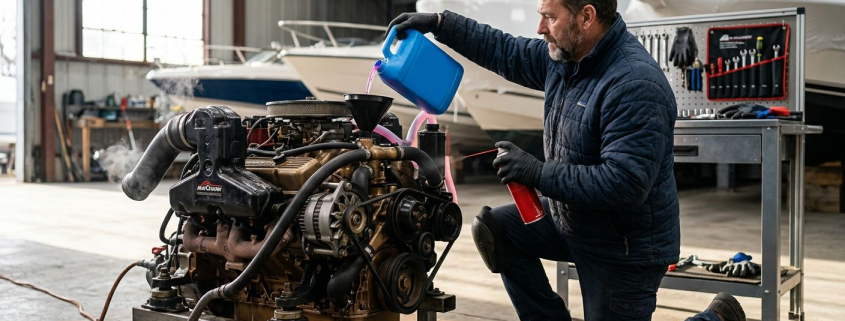
Professional marine technician applying fogging oil to an outboard engine for winterization in Toronto

Table of Contents

  • Marine Engine Fogging Oil Service in Toronto, Ontario: The Key to Winter Preservation
  • Prepare for Marine Engine Fogging in Toronto, Ontario
  • Gather the Right Supplies for Fogging in Toronto, Ontario
  • Warm Up and Disconnect Fuel Lines
  • Apply Fogging Oil to the Engine Intake
  • Shut Down and Seal the Engine
  • Protect External Engine Components
  • Professional Fogging at Your Dock in Toronto, Ontario
  • Check Your Engine After Winter Storage
  • Troubleshooting Common Fogging Issues for Marine Engines in Toronto, Ontario
  • Wrap Up Your Marine Engine Winterization with Fogging Service

Marine Engine Fogging Oil Service in Toronto, Ontario: The Key to Winter Preservation

A marine engine fogging oil service is a crucial winter preservation step for boat engines stored during Toronto’s cold off-season. During normal operation, combustion byproducts leave moisture and acidic residues inside the engine. Without marine engine winterization measures like fogging, these contaminants cause internal engine corrosion that can seize pistons and damage cylinder walls by spring. We apply a marine fogging oil treatment that coats all internal surfaces — cylinder walls, piston rings, and valve stems — with a thick protective film. For inboard engines, we spray the oil into the intake while the engine is running; for outboard motors, we inject it directly through spark plug ports and manually crank the engine to distribute the coating evenly. This internal engine corrosion protection is especially critical for boats stored in damp or unheated environments typical of outdoor shrink-wrapped storage. Entrusting your engine to our licensed technicians ensures thorough application and long-term preservation. At Boat Toronto Inc., our professional fogging oil service forms a key part of complete winterization packages, ensuring reliable starts and avoiding expensive spring repairs.

Prepare for Marine Engine Fogging in Toronto, Ontario

Preparing your boat for winter storage begins with a marine engine fogging oil service to protect internal engine components from corrosion. During Ontario’s harsh winters, moisture inside an idle engine can cause rust on cylinder walls and piston rings. Applying a marine fogging oil treatment creates a protective coating that provides effective internal engine corrosion protection, ensuring your engine’s reliability each spring.

Before you start fogging, gather the necessary supplies: marine-grade fogging oil, safety goggles, and a fuel shut-off tool. Always use marine-grade fogging oil formulated specifically for marine engines. Stabilize your fuel, run the engine to operating temperature, and then disconnect the fuel supply to prepare for the oil application. These preparatory steps are a key part of a comprehensive winterization plan, and we recommend following the marine engine winterization checklist provided by Boat Toronto for detailed guidance.

Once your engine is prepped and your supplies are in hand, you can proceed with the fogging procedure described in the next section. Proper preparation reduces the risk of internal damage and gives you peace of mind during the long Toronto winter.

Gather the Right Supplies for Fogging in Toronto, Ontario

Before you begin, having the correct materials on hand makes the process straightforward and safe. We recommend starting with a comprehensive marine engine fogging oil service by choosing a high-quality, marine-grade fogging oil designed specifically for internal engine corrosion protection. This is an essential step of proper marine engine winterization, as the oil coats cylinder walls and internal surfaces to prevent rust during long-term storage.

In addition to the fogging oil, you will need a spark plug socket and wrench, a funnel for precise application, and absorbent rags for cleanup. Always wear safety glasses and chemical-resistant gloves when handling any fogging product, as the chemicals can irritate skin and eyes.

These supplies are available at local marine parts stores in Toronto, Ontario, or through specialized online retailers. Boat Toronto’s winterization guidelines confirm that using a dedicated marine fogging oil treatment is the most effective way to protect your engine through the off-season. With everything gathered, you are ready to move on to the step-by-step fogging procedure.

Warm Up and Disconnect Fuel Lines

Now that you understand the importance of winterization, the first hands-on step is warming the engine. We start by running the motor to normal operating temperature, which thins the oil and allows it to circulate fully before the boat sits in storage. According to Mercury Marine outboard engines guidelines, this critical procedure helps prevent fuel system varnishing and ensures compliance with warranty terms.

Next, we disconnect the main fuel line at the engine connection while keeping the engine running. Allowing it to stall from fuel starvation is the most effective way to clear the carburetor of residual fuel, providing essential internal engine corrosion protection for the months ahead. Always perform this in a well-ventilated area to avoid the accumulation of exhaust fumes.

With the engine warm and fuel lines disconnected, the motor is ready for marine fogging oil treatment. This simple but vital sequence sets the foundation for a complete marine engine fogging oil service that safeguards your investment through the off-season.

Apply Fogging Oil to the Engine Intake

A professional marine engine fogging oil service is an essential step in winterizing your engine. This process delivers internal engine corrosion protection by coating cylinder walls and components with a protective film. This marine fogging oil treatment prevents rust and pitting while your boat is in storage.

  • Remove the flame arrestor or air filter to expose the intake, then start the engine and let it idle to reach operating temperature.
  • Spray marine-grade fogging oil into each carburetor throat or throttle body while the engine runs. Continue until the engine stalls, indicating the oil has coated the cylinders and valves.
  • For fuel-injected engines, use a dedicated kit that introduces oil through a vacuum line or throttle body; follow your engine manufacturer’s instructions.
  • After the engine stalls, turn off the ignition and replace the flame arrestor or air filter. Work in a well-ventilated area.

This simple process helps protect your investment throughout the off-season.

Vertical process flow showing four steps to apply fogging oil to a marine engine intake
Four-step process for applying fogging oil to a marine engine

After fogging, the engine is ready for storage or further winterization steps. For fogging oil and other marine maintenance supplies, visit West Marine.

Shut Down and Seal the Engine

Once the hull is prepped, turn attention to the engine. A complete marine engine fogging oil service is critical for shutting down and sealing your power plant. The purpose is simple: coat cylinder walls, piston rings, and valve seats with a protective film that delivers internal engine corrosion protection while the boat sits idle for months. Without this step, condensation can form on bare metal surfaces and lead to pitting or seizing.

Start by running the engine until it reaches normal operating temperature, then shut it off. Remove the air filter and, while a second person cranks the engine in short bursts, spray a generous volume of marine fogging oil treatment directly into the carburetor or throttle-body intake. Turn the engine over two or three more times after the last spray to spread the oil evenly across all internal surfaces. Follow up by sealing the exhaust outlet and air intake with tape or rubber plugs, which blocks moist air from entering the combustion chambers.

Change the engine oil and filter after fogging is complete so that acidic blow-by and suspended contaminants are drained away before storage. Taking these steps now helps prevent internal rust and makes for a smoother, drama-free startup when spring arrives. A properly fogged and sealed engine is ready for the next phase: covering and storing the boat.

Protect External Engine Components

While fuel system care is essential, we must also address the external components of your boat’s engine—the intake manifold, exhaust risers, and fuel injectors—that remain vulnerable to moisture and corrosion during storage. Our winterization process includes a critical step: a marine engine fogging oil service. This treatment sprays a specialized fogging oil into the engine’s intake while it runs, allowing the mist to coat internal surfaces and displace moisture. As the engine shuts off, the oil creates a durable protective layer that provides essential internal engine corrosion protection.

A proper marine fogging oil treatment is the most effective defense against the rust and pitting that can silently damage precision components over the winter. Without it, condensation can lead to expensive repairs, from seized piston rings to corroded valve seats. We ensure this fogging oil application is performed thoroughly, sealing your engine’s internals for the months ahead and connecting this protection directly to your boat’s reliability and safe operation when spring arrives. With the engine safeguarded, the next vital step is to turn our attention to the vessel’s interior and hull.

Professional Fogging at Your Dock in Toronto, Ontario

Fogging is a crucial part of marine engine preservation, involving our marine engine fogging oil service that coats internal cylinders with a protective layer. As part of our mobile winterization, we perform this service right at your dock in Toronto, Ontario, eliminating the need for trailering your boat to a facility.

This treatment provides essential internal engine corrosion protection by preventing moisture and rust from damaging pistons, rings, and cylinder walls during the off-season. Our experienced technicians use premium fogging oil to ensure every critical component is shielded, delivering the reliable marine fogging oil treatment your boat deserves.

Including fogging in your pre-winterization routine is a simple way to extend engine life and avoid costly repairs. Combined with shrink-wrapping or indoor storage, it provides comprehensive protection. For the most reliable service or to schedule, Call or Text us for more information.

Check Your Engine After Winter Storage

Before you turn the key for the first time this season, a thorough post-storage inspection is essential. The protective film left by a marine engine fogging oil service prevented rust during the layup, but you must now verify that every system is ready to run safely.

Start with a visual walk-around. Inspect the engine compartment for signs of nesting critters, loose wires, or pooled fluids. Next, complete these pre-start checks:

  • Pull the dipstick and check the oil level; look for a milky appearance that signals water intrusion
  • Squeeze every belt and hose, replacing any that feel brittle or show visible cracks
  • Inspect fuel lines and filters for gummed-up or stale fuel
  • Clean the battery terminals until they are bright, then confirm the voltage meets the manufacturer’s specification

Before cranking, rotate the engine by hand (with the spark plugs removed for safety) to circulate oil and confirm nothing is seized internally. This step reinforces the internal engine corrosion protection you maintained all winter. Once everything passes inspection, lightly re-fog critical surfaces with a quick marine fogging oil treatment to replenish any protective layers that may have settled.

After the initial start, listen closely for abnormal knocks or ticking and watch the exhaust for heavy smoke. If the engine runs smoothly and temperatures hold steady, you are ready to move on to the startup and break-in procedures. Should you discover any concern during these checks, we recommend having one of our technicians perform a professional evaluation before heading out on the water.

Troubleshooting Common Fogging Issues for Marine Engines in Toronto, Ontario

Proper engine fogging is one of the most critical steps in protecting your boat during winter storage, but sometimes it does not go as planned. Even with a high-quality marine engine fogging oil service, mistakes during application—like using the wrong type of oil, applying too much, or failing to distribute it evenly—can compromise internal engine corrosion protection. When you’re applying a marine fogging oil treatment in Toronto’s challenging climate, understanding these common pitfalls helps you avoid costly spring repairs.

  • Over-fogging and hydrostatic lock: Spraying excessive fogging oil into the cylinders can pool liquid inside the combustion chamber. When you crank the engine in spring, the incompressible oil can cause a hydrostatic lock, bending connecting rods or damaging pistons. Always follow manufacturer guidelines for the correct shot-per-cylinder amount, and remove spark plugs afterward to crank the engine briefly by hand—expelling any excess.
  • Under-fogging and corrosion spots: Applying too little oil leaves cylinder walls, rings, and valve stems exposed. In Toronto, freeze-thaw cycles create condensation inside the engine, accelerating rust on unprotected surfaces. A visible white smoke plume from the exhaust when fogging confirms full internal coating; if you don’t see it, reapply until coverage is complete.
  • Wrong oil selection: Only aerosol marine-grade fogging oil is formulated to cling to vertical cylinder walls and resist wash-off during temperature swings. General-purpose sprays or liquid oils may drain to the bottom of the cylinder, leaving the upper bore unprotected. West Marine stocks purpose-made formulas that cure to a tenacious protective film.
  • Skipping the post-fog run: After fogging an inboard engine, running it for 10–15 seconds distributes the oil evenly across all internal surfaces. Without this step, protection remains inconsistent—a common oversight among DIY boaters in Toronto who rush to finish winterization before the first hard freeze.

Our winterization team at Boat Toronto Inc. sees these issues every season and knows the precise amount, type, and technique required for lasting internal engine corrosion protection. By following the correct procedure—or entrusting the job to our licensed technicians—you significantly reduce the risk of rust, seizure, and expensive spring breakdowns. Call or Text us for more information about our mobile winterization services that bring professional-grade protection directly to your marina or storage yard.

Wrap Up Your Marine Engine Winterization with Fogging Service

After completing fuel stabilization, oil changes and water system draining, the final critical step is marine engine fogging oil service. We perform this procedure by spraying fogging oil into your engine’s intake or directly into the cylinders, coating internal surfaces like cylinder walls, piston rings and valve stems with a protective film. This marine fogging oil treatment displaces trapped moisture and seals the engine against humidity during months of inactivity.

By applying fogging oil after the other winterization tasks, we deliver thorough internal engine corrosion protection. This service helps prevent rust, reduces the risk of internal seizing and prepares your boat for an easy spring startup. Our technicians use state-of-the-art equipment to ensure even distribution inside your engine. We include fogging service as part of Boat Toronto’s winterization package, with flexible scheduling that fits your timeline.

Regular fogging extends engine life and protects your investment through Toronto’s harsh off-season. Call or Text us for more information about winterization, indoor storage or spring commissioning services.

Resources

  • Fog Your Marine Engine for Winter Protection
  • Comprehensive Guide to Marine Engine Winterization
  • Change Marine Oil and Filter Before Winter
  • Get Mobile Winterization Services for Your Boat
  • Understand Inboard vs Outboard Winterization Steps
  • Compare Professional and DIY Winterization Costs
  • Protect Your Boat with Full Winterization Services
  • Explore Mercury Marine Engines and Owner Support
  • Shop Marine Equipment and DIY Articles Online
July 1, 2026/by Lukas A
https://boattoronto.ca/wp-content/uploads/2026/07/featured-cc3d7410-2d7e-46da-8749-2a50291deba6.jpg 768 1408 Lukas A /wp-content/uploads/2024/05/logo-300x138.png Lukas A2026-07-01 18:56:372026-07-01 18:56:37Marine Engine Fogging Oil Service: Complete Protection Guide
Boat Maintenance & Storage, Boat Transport & Hauling, Boating Industry Guides, Logistics & Transportation, Marine Services

Boat Hauling Cost Per Kilometer Canada: Complete Pricing Guide

Table of Contents

  • Understanding Boat Hauling Costs in Canada
  • What Determines the Boat Hauling Cost Per Kilometer in Canada?
    • Distance and Route Factors
    • Boat Size and Weight Considerations
    • Fuel Surcharges and Seasonal Variations
    • Insurance and Permit Fees
  • Advantages of Professional Boat Transport Services in Canada
    • Specialized Equipment for Safe Handling
    • Local and Long-Distance Expertise
    • Comprehensive Insurance and Licensing
    • Time and Convenience Savings
  • How Boat Hauling Works: From Quote to Delivery in Canada
    • Getting Your Free Custom Quote
    • Preparing Your Boat for Transport
    • Loading, Securing, and Transit
    • Delivery, Launching, and Final Inspection
  • Tips for Choosing a Boat Transport Company in Canada
    • Verify Licensing and Insurance Coverage
    • Compare Quotes That Include Fuel Surcharges and Permits
    • Check Experience with Oversize Load Permits in Ontario
    • Read Reviews and Ask About Equipment
  • Getting an Accurate Boat Hauling Cost Estimate for Your Next Move

Understanding Boat Hauling Costs in Canada

When you’re moving a vessel, the boat hauling cost depends on several operational factors. For typical inland transport across Ontario and the rest of Canada, the boat hauling cost per kilometer averages between $3 and $10, with the rate shifting based on distance, boat size, and route complexity.

Long-distance moves generally offer a lower per-kilometer charge because fixed logistics costs are amortized over the entire journey. Conversely, short-haul trips under 50 km or moves requiring pilot cars, mountain routing, or extra crew days keep the per-km rate near the upper end of the range because setup, permits, and scheduling remain the same.

Key variables that shape your final quote include:

  • Boat length and weight: Vessels approaching 40 to 50 feet demand specialized equipment such as a Conolift hydraulic trailer, which ensures safer handling but raises the base rate.
  • Distance: Rates typically decrease per kilometre as the haul extends beyond 500 km — what would be a premium rate locally becomes more cost-effective over interprovincial routes.
  • Seasonal demand: Peak boating months and winter-storage deadlines often push per-km pricing higher; off-peak bookings can lower the cost.
  • Route permits and insurance level: Transporting an oversize boat — anything over 8.5 ft wide — in Ontario requires an oversize load permit, adding $200 to $800 per move. The required cargo insurance coverage also influences the line-item pricing.
  • Cross-border moves: Canada–US transport introduces customs documentation, duties, and border wait times, typically increasing the total cost by 15–25% compared to a domestic haul of the same distance.

Because every haul is unique, we calculate your cost per km for transporting a boat only after reviewing vessel specs and route details. To get a precise estimate for your boat and itinerary, request a free custom quote — an obligation-free step we walk you through in the next section.

What Determines the Boat Hauling Cost Per Kilometer in Canada?

The boat hauling cost per kilometer Canada varies based on a combination of factors that go well beyond simple mileage. Understanding these variables helps boat owners see the full picture when comparing quotes. From the specific route your vessel must travel to its dimensions and the time of year, each element influences the final rate. We break down the primary cost drivers so you know exactly what you’re paying for.

Distance and Route Factors

Distance is the most obvious starting point for any quote, but longer hauls often yield a lower boat hauling cost per kilometer Canada. This is because fixed costs like loading, securing, and permit administration are spread over more kilometers. For a complete breakdown of these and other factors, view our detailed guide on boat hauling cost.

Short trips of under 50 km are naturally more expensive on a per-km basis. Our 2026 rate comparison shows local moves in the Greater Toronto Area average between $3.00 and $4.50 per mile, while long-distance hauls beyond 500 km can drop to a more economical $2.00 to $3.50 per mile. Route complexity further adjusts these numbers. Navigating dense urban traffic in Toronto, crossing multiple provincial borders, or traversing remote areas with fewer services adds a logistical premium. Our team plans routes meticulously to ensure your boat’s safe and efficient transportation, accounting for these variables to keep your rate competitive.

Boat Size and Weight Considerations

The dimensions and weight of your vessel are critical cost factors, especially for larger boats. Our Conolift hydraulic trailer handles boats up to 50 feet with specialized tie-downs and custom-fit supports, which is reflected in the base price. The real shift in cost occurs when a boat is classified as an oversize load. According to the Ontario Ministry of Transportation (MTO) guidelines, any vessel exceeding standard width and height limits requires an oversize load permit.

Securing these oversize boat transport permits Ontario often adds a fixed surcharge of $200 to $800 to the total move. This fee typically covers the permit itself and, for particularly wide boats, the cost of required pilot or escort vehicles. It’s important to note that these are fixed costs, meaning they increase the per-km rate more noticeably on shorter routes. For your yacht transport Canada needs, we manage the entire regulatory process, including MTO permit applications, so these surcharges are presented transparently in your quote without hidden surprises.

Fuel Surcharges and Seasonal Variations

Fuel is a variable cost that directly impacts the boat hauling cost per kilometer Canada. We calculate fuel surcharges based on a weekly diesel index, commonly referencing the Ontario average. As diesel prices rise or fall, the surcharge adjusts to reflect the real cost of moving your boat. This ensures the pricing remains fair and directly tied to current market conditions.

Seasonal demand also plays a significant role. Peak season for boat transport in Canada runs from May through September, when high demand can push standard rates up by 15–25%. During this period, booking 4 to 8 weeks in advance is strongly recommended to secure availability. The winter months, while often considered off-peak for transport alone, see bundled demand as many owners combine hauling with winterization and storage services. We offer these packages to provide a seamless, cost-effective solution during the colder season.

Insurance and Permit Fees

A genuine professional service includes insurance coverage in the quote, but the extent of that coverage matters. We carry commercial cargo insurance to protect your vessel during transit up to a standard declared value. For higher-value boats, supplemental marine transport insurance can be added to cover the full replacement cost, which introduces a small increment to your per-km rate. This step is often essential for boats valued above $50,000.

Beyond insurance, mandatory permit fees are unavoidable for oversize moves. As outlined, oversize boat transport permits Ontario and any required escorts are billed at the actual cost of the permits. We don’t mark these up. Our team handles all permit logistics for you, keeping your cost competitive. For a precise boat hauling cost per kilometer Canada tailored to your vessel, the most reliable step is to request a free custom quote. Call or Text us for more information.

Advantages of Professional Boat Transport Services in Canada

When you own a boat, moving it from one location to another involves more than hitching up a trailer. The true boat hauling cost in the GTA reflects specialized equipment, insurance, and logistics expertise that protect your vessel at every stage. Understanding the boat hauling cost helps you see why professional transport is a smart investment. We combine proven regional experience with a fleet designed to handle boats up to 50 feet, so your vessel arrives safely and you avoid the hidden expenses of a DIY move. From local hauls in the Greater Toronto Area to coast-to-coast journeys, our approach delivers safe and efficient transportation without the risks of roadside breakdowns or permit delays.

Specialized Equipment for Safe Handling

We use a Conolift hydraulic trailer that cradles vessels up to 50 feet long, keeping the hull fully supported from haul-out through highway transit. Unlike standard roller trailers that concentrate pressure on a few contact points, the Conolift distributes weight evenly and absorbs road vibration that can cause gelcoat stress or structural fatigue. Custom tie-downs and padded contact surfaces prevent chafing and shifting, which is especially critical for wide-beam motor yachts and delicate racing sailboats. During winterization and storage transitions, the same equipment allows us to pick up your boat from the water, block it securely in our yard, and return it to the launch ramp without swapping trailers or hiring extra crews. Boaters in the GTA who also need engine work or shrink-wrapping can bundle those services with the haul, saving separate handling fees. Every load is inspected before departure, which significantly reduces risk for your boat’s hull, running gear, and topside finishes.

Local and Long-Distance Expertise

We serve a dense network of urban harbours, private docks, and suburban marinas throughout Southern Ontario, often providing same-day or next-day local hauls inside the GTA. For longer moves, we regularly run proven routes from Ontario to British Columbia and handle cross-border US-Canada shipments with in-house customs paperwork. This dual capability matters whether you are relocating a pontoon boat to a new cottage lake or arranging yacht transport Canada for a seasonal migration to the West Coast. We also coordinate storage, and repairs at the destination so your boat is winterized and under cover as soon as it arrives. Our drivers know which corridors have height clearances for flybridge cruisers, where to plan fuel stops for oversized combinations, and how to adjust for mountain grades that strain standard tow rigs.

Comprehensive Insurance and Licensing

Our commercial marine liability coverage is designed specifically for boat transport, not adapted from an auto policy, and it applies during haul-out, highway movement, and launch. We carry the required oversize boat transport permits Ontario authorities issue for loads exceeding standard width and height, and we coordinate pilot cars or escorts when provincial rules demand them. This ensures your move complies with Ministry of Transportation regulations from the first kilometre to the last. Before we take the wheel, we confirm route surveys, permit validity, and coverage limits so you are protected against incident-related damage. Instead of arranging single-trip permits on your own and hoping your personal auto insurer will respond, you gain a fully compliant move backed by industry-specific safeguards.

Time and Convenience Savings

Owning or renting a tow vehicle rated for heavy marine loads, securing wide-load permits, and dealing with unexpected roadside problems can devour spring weekends and add hundreds of dollars in hidden costs. Our crews handle everything: we bring the right truck, the right trailer, and the right paperwork. Because we also offer storage, and repairs, we can pick up your boat, complete winterization at our secure yard, and deliver it back to the launch ramp when the season starts. You avoid driving a rig you are unfamiliar with, waiting for permit approvals, or risking a breakdown on a long highway haul. When you factor in the true boat hauling cost per kilometer Canada applies, professional transport eliminates the major time sinks and stress points that come with a DIY approach. Call or Text us for more information and a free custom quote for your next move.

How Boat Hauling Works: From Quote to Delivery in Canada

Once you decide to ship your boat instead of sailing or trailering it yourself, understanding the full process removes the guesswork and lets you plan confidently. Understanding the total boat shipping cost in Canada helps you plan your budget before you even request a quote. Our team at Boat Toronto manages every detail, from the first measurement to final launch, so you never have to coordinate permits, escorts, or specialized equipment on your own. Here is exactly how our boat hauling service works when you book with us.

Getting Your Free Custom Quote

The first step is a quick conversation by phone, text, or our online form. We ask for your boat’s key dimensions including length, beam, and approximate weight, along with the pick-up and delivery postal codes and your preferred timing. With that information we calculate a transparent per-kilometre estimate that covers permits, escort vehicles when legally required, fuel surcharges, and full insurance. For a long-distance move the boat hauling cost per kilometer in Canada becomes the clearest way to compare options, and our quote breaks it down so there are no surprises. Most quotes are returned within 24 hours, and we can bundle hauling with winterization, repairs, or storage if your boat needs additional work before or after the trip.

Preparing Your Boat for Transport

Proper preparation protects your boat and keeps the schedule on track. Before our crew arrives, owners should complete a short checklist:

  • Remove all loose gear, electronics, and personal items from the cabin and deck
  • Secure or remove batteries, making sure terminals are protected
  • Drain fuel and water tanks if our dispatch team advises it for your route
  • Verify that your own insurance policy covers the transport period

We handle the rest, including inspecting attachment points and confirming that hatches, windows, and doors are sealed. Taking these steps ahead of time lets us load your boat safely the moment our trailer is in position.

Loading, Securing, and Transit

On pick-up day our Conolift hydraulic trailer arrives at your marina, storage yard, or private dock. Because the trailer’s hydraulic arms lift the boat cradle directly, we do not need a launch ramp or a separate trailer to start the haul-out. Our crew positions custom supports and wraps bow straps and multiple tie-downs to lock the hull in place. Before we roll, we obtain any oversize boat transport permits Ontario authorities require and schedule pilot or escort vehicles where regulations call for them. Throughout the transit our drivers follow a pre-planned route that accounts for bridge clearances, road restrictions, and weather, giving your boat a smooth, protected ride whether it is a yacht transport Canada move or a shorter regional trip.

Delivery, Launching, and Final Inspection

After the boat arrives safely at its destination, we unload using the same hydraulic system that lifted it at the start of the run. If a suitable ramp is nearby, we can offer optional launching right into the water so your boat is ready to use immediately. Before we consider the job complete, we walk through a joint inspection with you, documenting the hull, running gear, and topsides to confirm nothing shifted during transit. The final paperwork includes the bill of lading and proof of insurance coverage for the full trip. Call or text us for more information or to schedule your transport, and we will guide you through every step from quote to delivery.

Comparison: Tow-Away vs. Flatdeck Trailer vs. Conolift Hydraulic Trailer

This table helps Canadian boat owners choose the right transport method based on cost, boat size, and convenience.

Comparison: Tow-Away vs. Flatdeck Trailer vs. Conolift Hydraulic Trailer
Transport MethodTypical Per-Kilometer RateBest ForPermit ComplexityRamp/Launch Capability
Tow-Away (on own trailer)Lower (fuel + tolls only)Small boats under 25 ft, short distancesLow – usually no oversize permitsYes (if trailer is adapted)
Flatdeck / Step-deck TrailerModerate (average market rate)Boats 25–40 ft, standard beamMedium – oversize permits often requiredLimited – needs extra equipment
Conolift Hydraulic Trailer (Boat Toronto)Competitive (all-inclusive)Boats up to 50 ft, wide beams, long distancesManaged by provider – hassle-freeYes – hydraulic lift for haul-out and launch

Our Conolift hydraulic trailer handles vessels up to 50 ft without a separate trailer, and the competitive all-inclusive rate bundles permit costs and escort vehicle fees so you see one straightforward number. Fuel surcharges typically run 10–15% of the base rate depending on diesel prices, and those are already included when we deliver your quote. Whichever method you are comparing, choosing a provider that manages permits and insurance on your behalf turns a complex move into a simple, predictable trip.

Boat hauling process: quote, prepare, load, transit, launch.

Tips for Choosing a Boat Transport Company in Canada

Once you understand your transport options, you need to vet the company handling your vessel. Selecting a carrier involves more than comparing a single price—it means verifying credentials, dissecting quotes, and confirming the company has the right experience and equipment for your specific boat. We recommend a systematic approach that protects your investment at every step.

Verify Licensing and Insurance Coverage

Confirm that any transporter you consider carries full commercial operating authority in Canada and holds valid marine cargo insurance. The policy must cover your boat’s full agreed value—not a depreciated market figure—so request a certificate of insurance that names your vessel. According to Metropolitan Logistics, standard carrier liability varies by shipment, and supplemental coverage is necessary for boats worth more than CAD $50,000. We also recommend asking whether the policy covers haul-out, road transit, and launching as separate events. Never sign a contract until you have the insurance binder in hand and have confirmed its expiry date.

Compare Quotes That Include Fuel Surcharges and Permits

Ask for an itemized quote that breaks out every fee instead of presenting a flat per-km figure. A transparent estimate should list the base rate, the fuel surcharge percentage or floating index, permit acquisition charges, pilot vehicle escorts, and any tolls or bridge fees. When evaluating boat hauling cost per kilometer canada, remember that long-haul per-km pricing in Canada typically decreases with distance. For instance, Boat Toronto’s 2026 rate data shows local Toronto moves under 50 km averaging $3.00–$4.50 per mile, while long-distance hauls over 500 km sit at $2.00–$3.50 per mile—a pattern that reflects economies of scale. Insist that fuel surcharges are capped or calculated on a published index so you can verify them independently.

Check Experience with Oversize Load Permits in Ontario

Any boat wider than 8.5 feet triggers Ontario’s oversize regulations, and the carrier must manage oversize boat transport permits Ontario requires. The Ministry of Transportation mandates an Over-Dimensional Permit, a route survey that accounts for bridge clearances and construction zones, and in many cases front and rear pilot vehicles. We advise you to ask a prospective carrier for their permit history with the MTO—not just a general claim of experience. The right provider can explain how they coordinate with provincial inspectors, how far in advance they apply for permits, and what contingencies they build into the schedule if road restrictions change mid-route.

Read Reviews and Ask About Equipment

Look beyond star ratings and read Google reviews that mention long-distance or interprovincial moves; these testimonials reveal how a company handles multi-day logistics. Check the carrier’s Better Business Bureau profile for unresolved complaints. Then ask for photos of the specific trailer that will haul your boat. A boat needing yacht transport Canada services may require a Conolift hydraulic trailer or a reinforced flatdeck that matches the vessel’s beam, keel depth, and weight. Confirm that the trailer is rated for your boat’s exact length and that the company uses custom-fit supports and tie-downs. This attention to equipment is what separates the most reliable boat transport from a basic towing service. After confirming the company’s credentials, the next step is preparing your boat for hauling.

Getting an Accurate Boat Hauling Cost Estimate for Your Next Move

Now that you understand the general cost factors, the real challenge is getting an accurate figure for your specific move. The boat hauling cost per kilometer in Canada typically depends on several real-world variables that generic online calculators can overlook. When you request a free custom quote from us, we account for your vessel’s unique logistics—not just a standardized rate.

The key pricing factors include distance travelled, overall boat length up to 50 feet, seasonal demand peaks in spring and summer, and whether your move requires oversize boat transport permits in Ontario. While industry data from BoatToronto.ca shows that rates in Canada often fall between $2.50 and $5.00 per km for standard boats, an oversize load with special routing and permits will increase the per-kilometre rate. The most accurate approach is to share your boat’s exact length, beam width, approximate weight, current location, and destination address so we can build a precise estimate.

Beyond the base rate, always ask the right questions. Does your quote include permit fees, loading and unloading, and insurance coverage for the full value of your boat? Are there extra charges for rural road access or tight marina approaches? For yacht transport in Canada, the most reliable boat transport companies—including our team at BoatToronto.ca—provide transparent quotes so you can compare two or three offers confidently. After you receive your custom quote, you can easily schedule your transport with our team.

Resources

  • Get Boat Hauling Cost per Mile in Canada
  • Learn Factors Affecting Boat Hauling Prices
  • Find Average Boat Transport Cost in GTA
  • Get Free Boat Hauling Quotes in Toronto
  • Compare 2026 Boat Hauling Costs per Mile
  • Discover Full Marine Services by Boat Toronto
  • Learn About Dependable Boat Transport Services
  • Get Boat Shipping Costs per Kilometer in Canada
June 25, 2026/by Lukas A
/wp-content/uploads/2024/05/logo-300x138.png 0 0 Lukas A /wp-content/uploads/2024/05/logo-300x138.png Lukas A2026-06-25 18:40:022026-06-25 18:40:02Boat Hauling Cost Per Kilometer Canada: Complete Pricing Guide
Boat Maintenance & Repairs, Boat Storage & Winterization, Boat Transport, Marine Services, Towing & Hauling Guide, Transport Preparation

Boat Transport Preparation Checklist: Complete Guide

Professional marine technician applying shrink wrap to a boat on a hydraulic trailer at a Toronto marina

Table of Contents

  • Getting Your Vessel Ready for Road Transport in Toronto, Ontario
  • Before You Start Your Boat Transport Preparation
  • Remove Loose Items and Secure Electronics
    • Instructions
    • Why It Matters
    • Tips
  • Drain Fuel, Water, and Holding Tanks
    • Instructions
    • Why It Matters
    • Tips
  • Inspect the Hull and Running Gear
    • Instructions
    • Why It Matters
    • Tips
  • Protect the Boat with Shrink Wrap or Covers
  • Secure the Boat for Highway Travel
    • Instructions
    • Why It Matters
    • Tips
  • Check Height, Width, and Weight Requirements
  • Final Walk-Through and Documentation
  • Troubleshooting Common Issues During Boat Transport Preparation
  • Trust Professional Haulers for Your Boat Transport Needs

Getting Your Vessel Ready for Road Transport in Toronto, Ontario

Follow this boat transport preparation checklist to ensure a smooth, safe haul. Properly preparing your boat in Toronto, Ontario, safeguards your investment and streamlines the entire process.

  • Drain tanks: Remove fuel, water, and waste to meet regulations and reduce transport weight.
  • Secure loose gear: Detach antennas, electronics, cushions, and personal belongings; stow them safely.
  • Add shrink wrap protection: We shield your vessel against road debris, weather, and UV exposure.
  • Schedule a boat hull inspection: Our technicians check for cracks or blisters before the journey.
  • Disconnect the battery: This prevents fire risks and electrical damage during transit.
  • Review your insurance: Verify your policy includes overland coverage, or ask us about dedicated transport protection.

Keep your registration and insurance documents accessible for the carrier. With your vessel prepared, trust our experienced team for professional boat hauling in Toronto. Call or Text us for more information or a free custom quote to secure safe and efficient transportation.

Before You Start Your Boat Transport Preparation

A proper boat transport preparation checklist ensures your vessel arrives at its destination safely and without incident. According to our FAQ, careful pre-transport checks significantly reduce the risk of damage during transit and loading. We’ve compiled this essential checklist to guide you through every step.

  • Perform a thorough boat hull inspection. Look for any existing cracks, blisters, or structural weaknesses that could worsen while in transit. Documenting these beforehand is crucial.
  • Remove all loose personal items, electronics, fishing gear, and removable cushions. This prevents them from shifting, getting lost, or causing damage during the journey.
  • For long-distance hauls, we highly recommend professional shrink wrap protection. This critical layer safeguards your vessel against road debris, weather, and grime.
  • Securely fasten all hatches, doors, antennas, and any protruding components. Ensure outboard motors or other accessories are locked down to meet strict road safety requirements.
  • Document your vessel’s overall condition with clear, dated photos before loading commences. This serves as your essential pre-transport visual record.
  • Confirm that you have adequate boat transport insurance in Canada well in advance of the scheduled haul.
  • Drain fuel and water systems as required by your transporter, and disconnect the batteries to prevent electrical issues or hazards during the move.
  • Gather all essential documentation for the carrier’s review, including your boat’s ownership, registration, and insurance certificates.

Remove Loose Items and Secure Electronics

After completing exterior inspections, the next step is to remove all loose items from inside the boat. As part of your boat transport preparation checklist, our team recommends clearing every compartment, bin, and seat area completely. This interior preparation is just as critical as any hull inspection and helps guarantee safe and efficient transportation.

Instructions

Remove all loose gear including lines, fenders, dock bumpers, cushions, canvas, fishing rods, and personal belongings. Take out all electronics such as GPS units, fish finders, radios, and batteries, and pack them separately in padded containers. Finally, label all wires and cables before disconnecting them to simplify reinstallation. By following these steps, you ensure safe and efficient transportation of your boat.

Why It Matters

Unsecured items shift during transit and can crack screens, scratch gelcoat, or dent compartments. In sudden stops, loose gear becomes a dangerous projectile. If electronics are damaged during transit, your boat transport insurance in Canada may cover the replacement, but only if proper preparation steps are followed. According to BoatToronto’s own towing and hauling guidance, securing or removing all detachable gear is a standard industry practice.

Tips

Use foam-lined boxes for sensitive electronics and check that nothing is left in cup holders or compartments. If you have canvas with shrink wrap, remove and store it separately to prevent moisture entrapment. Store registration documents in a safe, accessible place, and ensure the hull inspection focuses on the exterior while interior preparation remains equally important.

Drain Fuel, Water, and Holding Tanks

Once the boat is clean and accessible, the next critical step is draining all tanks. As part of your boat transport preparation checklist, draining the Fuel Tank, Fresh Water System, and Holding Tank is a task we perform meticulously to ensure safe and efficient transportation.

Instructions

  • Fuel Tank: Run the engine briefly to clear the fuel lines, or siphon the tank directly. Always disconnect the batteries and propane system before you begin to eliminate any risk of ignition.
  • Fresh Water System: Open all low-point drains and run the faucets until the system is empty. This prevents freeze damage and reduces unnecessary weight.
  • Holding Tank: Use a pump-out station or gravity drain to empty the tank completely. This is a non-negotiable step for enclosed systems.

Why It Matters

Draining all tanks significantly reduces transport weight and prevents hazardous spills caused by sloshing liquids. This step in the boat transport preparation checklist ensures we remain compliant with transport regulations, as a full drain of enclosed holding tanks is legally required to avoid environmental fines. A drained system also provides better access for a thorough boat hull inspection in Toronto.

Tips

  • Use a fuel stabilizer if you are only partially draining the tank.
  • Run the engine for a few seconds to clear any remaining fuel from the lines.
  • Clearly mark all drain valves for a quick and easy refill at your destination.
  • After draining, the boat is ready for shrink wrap protection in Toronto, which prevents moisture buildup during transit.

Inspect the Hull and Running Gear

As part of your boat transport preparation checklist, inspecting the hull and running gear is essential to ensure a damage-free haul-out. With the boat cleared, now we perform a thorough examination of the structure and mechanical components.

Instructions

  • Visually scan the hull for cracks, blisters, impact damage, and gelcoat deterioration, using a flashlight and mirror for hard-to-see under-sections.
  • Check each propeller blade for nicks, bends, and correct pitch, confirming no debris is wrapped around the shaft.
  • Inspect the rudder for corrosion, secure attachment, and free movement through its full range.
  • Examine the shaft for alignment, corrosion, and proper seal integrity.
  • Verify trim tabs operate freely and are not bent or damaged.

Why It Matters

A thorough boat hull inspection prevents further damage during haul-out and transport by identifying weak points before the vessel is lifted. As we position support straps and cradle the hull, any existing cracks or compromised running gear can worsen, making detection and repair before the move essential for safe and efficient transportation.

Tips

  • Use a detailed checklist to record the condition of all components, ensuring nothing is overlooked.
  • Take clear, time-stamped photos of any visible damage for insurance purposes and your records.
  • Contact our team to address any needed repairs before transport — call or text us for a free custom quote, and our licensed technicians will prepare your boat properly.

Protect the Boat with Shrink Wrap or Covers

Once you’ve inspected the hull, the next step in your boat transport preparation checklist is to shield your vessel from the elements. We ensure boats in Toronto and across the GTA stay safe during transport by applying shrink wrap or high-quality protective covers.

Instructions

We recommend starting with a clean, dry surface and taping all vents and openings securely. Next, apply strapping around the hull and over the gunwales to anchor the wrap. Heat-shrink the material evenly until it forms a drum-tight skin over the boat. For peace of mind, BoatToronto offers professional shrink wrap protection as part of our winterization and transport preparation services.

Horizontal process flow showing four boat shrink-wrapping steps: clean surface and tape vents, apply strapping, heat-shrink wrap, inspect and reinforce corners Four steps to professionally shrink-wrap a boat

Why It Matters

After a thorough boat hull inspection, shrink wrap creates a water-, wind-, and dust-tight seal. This barrier defends your gel coat, fittings, and electronics from road debris and UV exposure during long hauls. It is an essential layer of armor for your vessel.

Tips

Always use vented covers or leave small openings to prevent moisture buildup and mildew under the wrap. Reinforce corners and high-wear edges with extra padding to avoid tears at highway speeds. For boats over 30 feet, we recommend professional shrink-wrapping for a secure and custom fit every time. With the boat properly wrapped, you’re ready to secure it for the journey.

Secure the Boat for Highway Travel

Once the boat is prepared for travel, the next critical step is securing it on the trailer. As a fundamental part of your complete boat transport preparation checklist, proper tie-downs are the most important safety measure you can take before hitting the road. We recommend a methodical approach that begins with a thorough boat hull inspection to ensure the vessel is in sound condition for the journey ahead.

Instructions

  1. Attach a bow strap and a stern strap to the trailer’s approved tie-down points, never to axles or suspension parts.
  2. Inspect all trailer rollers and bunk supports for alignment and wear, and complete your boat hull inspection before strapping.
  3. Verify that 10–15% of the total weight rests on the trailer tongue and adjust the boat’s position if needed.
  4. Tighten the ratchet straps evenly until snug; avoid over-tightening that could stress or crack the hull.
  5. After driving 5–10 miles, pull over and recheck all strap tensions and connections.

Why It Matters

Proper tie-downs prevent the boat from shifting on the trailer, which can cause catastrophic damage, loss of control, or highway accidents. Following a complete boat transport preparation checklist means every component is inspected, and the vessel is immobilized for the duration of the trip. According to BoatToronto’s transport preparation FAQ, consistent tension checks greatly reduce the chance of load movement.

Tips

  • Before traveling, confirm that shrink wrap protection is intact and will not loosen at highway speeds.
  • Use bow and stern straps with tension indicators, and re-tension after the first few miles to account for any settling.
  • Never over-crank the straps; a firm, even hold is safer than maximum tension.

Check Height, Width, and Weight Requirements

Once your boat is fully prepared, the next critical step is verifying its dimensions and weight for legal road travel. A thorough boat transport preparation checklist must include careful measurement and verification against the rules of the road in Ontario to avoid costly penalties.

Instructions

To begin, measure your boat’s overall height while it is securely resting on the trailer. This must include any accessories like radar arches and, crucially, any shrink wrap protection that has been applied, as it adds several inches. Next, verify the beam (width) at its widest point. In Ontario, the typical maximum width allowed without a permit is 2.6 meters (8.5 feet), and the maximum height is 4.15 meters (13.5 feet). For weight, calculate the combined mass of the boat, trailer, fuel, and gear. If any dimension exceeds these legal limits, you will need to obtain an over-dimensional permit from the Ministry of Transportation of Ontario (MTO) before moving the vessel.

Dimension Standard Limit Requirements Over Limit
Width (Beam) 2.6m (8.5ft) Oversize Permit & Signage
Height 4.15m (13.6ft) Route Planning & Permit

Why It Matters

Confirming your boat’s size compliance is foundational to safe and efficient transportation. We recommend incorporating a boat hull inspection before this step, as a past repair or modification to the trailer or hull could unexpectedly change your total weight. Ignoring these checks leads to risk. Moving a boat without required permits in Ontario can result in significant fines, sudden route restrictions, and serious damage from collisions with low bridges or narrow lanes, turning a simple move into a major liability.

Final Walk-Through and Documentation

Once all preparation steps are complete, a final walk-through ensures nothing is overlooked and all documentation is ready. We recommend using a boat transport preparation checklist to verify every step is completed before the carrier arrives.

Instructions

  • Verify tie-downs, straps, and cover security, checking for tears or loose areas, especially in shrink wrap protection.
  • Confirm all hatches, windows, and access points are securely latched.
  • Conduct a boat hull inspection for debris, protruding hardware, or damage.
  • Check the engine cut-off switch, battery disconnect, and fuel lines per manufacturer recommendations.
  • Ensure all documentation—insurance certificate, transport permits, and boat registration—is inside the vehicle.

Troubleshooting Common Issues During Boat Transport Preparation

Even with a thorough pre-trip checklist, certain issues can arise during preparation. As part of your broader boat transport preparation checklist in Toronto, it is wise to anticipate these common snags and know how to handle them efficiently. A detailed boat hull inspection often reveals the first challenges, and addressing them early ensures your vessel is truly ready for the road.

Hull Damage Discovered During Inspection

A careful boat hull inspection is a fundamental preparation step, but the discovery of cracks or blistering can be unsettling. If you find damage, do not attempt a temporary DIY patch. Contact our service team for a professional assessment and permanent repair before the boat is loaded. This approach ensures your hull is structurally sound and prevents minor damage from worsening due to vibration during transit.

Trust Professional Haulers for Your Boat Transport Needs

We know that a thorough boat transport preparation checklist starts with careful planning, but executing a safe move requires licensed professionals. Our team protects your investment at every stage by providing the most reliable boat transport in the region.

Every move includes a detailed boat hull inspection and shrink wrap protection to secure your boat against weather and road debris. By verifying the pre-trip inspection, marine shrink-wrap, and required permits ourselves, we save you time and reduce the risk of fines or delays.

Contact us today for a free custom quote and experience safe and efficient transportation with a team that treats your boat like its own. Call or Text us for more information.

Resources

  • Get Professional Boat Hauling and Marine Services
  • Learn about Boat Transport Insurance in Canada
  • Get Comprehensive Boat Transportation and Storage
  • Get Boat Hauling, Towing, and Marine Services
  • Get Reliable Boat Hauling and Maintenance Services
  • Get Full-Service Boat Transport and Storage
  • Get Boat Trailer Transport Services in Toronto
June 25, 2026/by Lukas A
https://boattoronto.ca/wp-content/uploads/2026/06/featured-a61385de-9b77-40da-99d3-91cc82c8c2bb.jpg 768 1408 Lukas A /wp-content/uploads/2024/05/logo-300x138.png Lukas A2026-06-25 18:40:022026-06-25 18:40:02Boat Transport Preparation Checklist: Complete Guide
Boat Maintenance & Storage, Boat Transport & Hauling, Boating Services, Marine Regulations & Safety, Oversized Load Logistics, Toronto Marine Industry

Oversized Boat Transport: Complete Guide for 2026

Large cabin cruiser securely loaded on a Conolift hydraulic trailer with Toronto skyline in background, transport professional inspecting tie-downs in warm afternoon light.

Table of Contents

  • Essential Guide to Oversized Boat Transport in Toronto, Ontario
  • Understanding Permit Requirements for Oversized Boat Hauling in Ontario
  • Navigating Height Restrictions and Route Planning for Oversized Boats
    • Measuring Your Boat’s Dimensions for Route Compliance
    • Identifying Bridge Height Restrictions on Ontario Highways
    • Working with Pilot Car Services for Safe Oversize Transport
  • Preparing Your Oversized Boat for Safe and Efficient Transport
    • Gathering Required Documentation and Permits
    • Securing Your Boat with Proper Tie-Downs and Supports
    • Final Pre-Transport Inspection Checklist
  • Insurance and Cost Considerations for Oversized Boat Hauling
  • Frequently Asked Questions About Oversized Boat Transport
  • Secure Your Oversized Boat Transport with Confidence

Essential Guide to Oversized Boat Transport in Toronto, Ontario

Oversized boat transport requires specialized equipment and careful planning to ensure your vessel moves safely from origin to destination. If you own a large vessel that exceeds standard road width or height limits, standard towing simply will not work. Our team at BoatToronto understands that moving an oversized hull means navigating complex logistics with professional skill.

We use a Conolift hydraulic trailer capable of handling boats up to 50 feet, which sets us apart for boat transport in Toronto. This equipment provides a secure cradle during transit, making it ideal for wide load boat transport on Ontario highways and local roads. A specialized hydraulic boat trailer transport setup gives us the flexibility to adjust the boat’s position, which helps clear obstacles that a fixed trailer cannot.

Key considerations for oversized moves include:

  • Proper permits and escort vehicles required by Ontario regulations
  • Route planning that checks bridge clearances, overpass heights, and construction zones
  • Licensed, insured carriers with experience in oversize load logistics
  • Pre-trip inspection of tie-downs, lights, and support pads for safe and efficient transportation

We hold all necessary licensing and insurance for oversize loads, which means you avoid penalties and delays. Our crew studies route options around the Greater Toronto Area, identifying potential hurdles such as narrow bridges or temporary roadwork before departure. The most reliable boat transport comes from preparation, not shortcuts.

For additional details, visit our boat transport in Toronto FAQ page. When you are ready to move your large vessel, call or text us for a free custom quote. We will design a transport plan that puts safety first, whether you are crossing town or heading across the province.

Understanding Permit Requirements for Oversized Boat Hauling in Ontario

When planning oversized boat transport in Ontario, understanding the legal requirements is essential to avoid penalties and ensure safe passage. We prioritize safe and efficient transportation for every vessel, and part of that commitment means helping you navigate the regulatory landscape. Before any oversized boat transport move can begin, it is crucial to know the dimension thresholds that trigger permit obligations and when a pilot car becomes mandatory.

The Ontario Ministry of Transportation (MTO) defines specific limits for width, height, length, and weight. Exceeding any one of these thresholds means your load is legally oversize or overweight and requires an Oversize/Overweight Permit. The table below summarizes the key dimension limits, permit requirements, and pilot car rules for hauling oversized boats.

The following comparison outlines the critical dimensions and their associated requirements:

Oversize Load Requirements in Ontario by Dimension
DimensionThresholdPermit RequiredPilot Car Required
WidthOver 2.6 m (8.5 ft)Yes – Oversize/Overweight PermitYes, if over 3.75 m (12.3 ft) wide
HeightOver 4.15 m (13.6 ft)Yes – Oversize/Overweight PermitYes, if over 4.4 m (14.4 ft) high
LengthOver 25 m (82 ft)Yes – Oversize/Overweight PermitYes, if over 30 m (98 ft)
WeightOver 55,000 kg (121,254 lbs) gross vehicle weightYes – Oversize/Overweight PermitDepending on route and weight distribution

For width, any boat exceeding 2.6 metres requires a permit, and once it surpasses 3.75 metres wide, a pilot car must accompany the load. Height follows a similar structure, with the permit triggered at 4.15 metres and a pilot car needed above 4.4 metres. Length restrictions mandate permits for loads over 25 metres, with pilot car requirements kicking in beyond 30 metres. Weight limits are based on gross vehicle weight; crossing the 55,000-kilogram threshold always demands an Oversize/Overweight Permit, and pilot car obligations may depend on the specific route and weight distribution.

These rules are enforced by the MTO and align with overarching regulations from Transport Canada for oversize loads on public highways. When moving a wide load boat transport with our hydraulic boat trailer transport equipment, we account for all dimensional requirements from the start. Our experience with oversized boat transport means we factor in these permits and pilot car needs during the planning phase.

A common point of confusion is the distinction between a pleasure craft licence and an oversize transport permit. A pleasure craft licence proves you own the boat, similar to a vehicle registration document. It is completely separate from an Oversize/Overweight Permit, which is the mandatory authorization for moving a vessel that exceeds legal dimension or weight limits on Ontario roads. You cannot substitute a pleasure craft licence for a transport permit, and failing to secure the correct permit can lead to significant fines and delays.

Comparison chart of Ontario oversize load dimension thresholds for width, height, length, and weight, showing permit and pilot car requirements.

Ontario oversize load dimension threshold comparison for boat transport.

Compliance with these regulations is a fundamental part of The most reliable boat transport we deliver. Route and time-of-day restrictions can impact permit conditions, so we recommend consulting the MTO directly for trip-specific information. Once you know which dimensions require permits, the next step is to apply through MTO, a process that we cover in the following section.

Call or Text us for more information about your specific boat transport needs.

Navigating Height Restrictions and Route Planning for Oversized Boats

Planning oversized boat transport on Ontario highways demands careful attention to height restrictions and strategic route selection. Whether you are moving a yacht across the Greater Toronto Area or hauling a sailboat to a seasonal storage facility, understanding your vessel’s dimensions and the obstacles you may encounter is the first step toward a smooth journey. Bridge clearances, overpass height limits, and road regulations all dictate which routes are safe and legal. Professional planning not only prevents damage to your boat but also avoids costly delays and fines. We emphasize meticulous preparation, using the right equipment and expertise to manage every detail.

Measuring Your Boat’s Dimensions for Route Compliance

Accurate measurements are the foundation of any successful wide load boat transport. Begin by measuring the overall height from the ground to the highest fixed point on your boat when it is loaded on its trailer. This includes radar arches, flybridges, or tuna towers that can easily be overlooked. Next, record the width at the widest point, typically the beam, ensuring that any protruding cleats or rub rails are included. Finally, note the combined length of the boat and trailer, as this determines whether you need pilot car escorts under Ontario’s oversize regulations.

Our internal FAQ provides step-by-step guidance on measuring your boat precisely, including tips for accounting for suspension compression when the boat settles on the trailer. BoatToronto can assist with this process, as we routinely measure boats for safe transport using our hydraulic boat trailer transport system, the Conolift, which handles vessels up to 50 feet. Once you have these numbers, you can compare them against the clearance data for Ontario’s major highways, which we cover in the next section.

Identifying Bridge Height Restrictions on Ontario Highways

Ontario highways present varying bridge clearance heights that directly affect oversize load routing. The table below summarizes common clearances on key routes used for large-boat transport, drawn from Ontario Ministry of Transportation bridge inventory data and pilot car service reports.

Bridge Clearance Comparison on Major Ontario Routes
RouteBridge / LocationClearance HeightNotes
Highway 401 (Greater Toronto Area)Keating Ave. overpass4.4 m (14.4 ft)Standard minimum for most routes; verify before travel.
Queen Elizabeth Way (QEW)Burlington Skyway4.5 m (14.8 ft)Marine clearance much higher; road clearance still applies for trailer.
Highway 400 (North of Toronto)Hwy 400 overpasses near Barrie4.3 m (14.1 ft)Some lower clearances require alternate routing.
Highway 407 (Toll Route)Various overpasses4.4 m (14.4 ft)Higher tolls but often fewer height restrictions.

These figures illustrate why careful route planning is essential—a boat that fits under the Burlington Skyway may still encounter low-clearance bridges north of Toronto on Highway 400. When your boat’s height approaches or exceeds these limits, alternate routing or escort services become necessary.

Working with Pilot Car Services for Safe Oversize Transport

Pilot cars are mandatory in Ontario when a load exceeds certain width thresholds, typically 2.6 meters, though height and length can also trigger escort requirements. A pilot car acts as an advance warning to other drivers and scouts for low bridges, narrow lanes, and construction zones. The pilot vehicle stays ahead of the transport, communicating with our driver to adjust speed or switch lanes well before an obstacle appears. This coordination greatly reduces the risk of a bridge strike or traffic disruption.

For oversized loads, we arrange qualified pilot car services that are familiar with Ontario’s major corridors and the quirks of boat hauling. During a recent move of a 45-foot boat from Toronto to Barrie, our team used pilot escorts to navigate Highway 400’s tighter sections without incident. The combination of experienced hydraulic boat trailer transport and professional escort drivers ensures your boat arrives safely, even on routes with known height constraints. If your boat’s measurements suggest pilot cars are needed, we will include them in your transport plan as part of our free custom quote.

With the right measurements, route intelligence, and pilot car coordination, your oversize boat haul becomes a predictable, worry-free operation. Next, securing the necessary permits seals the plan and clears the way for a successful journey.

Preparing Your Oversized Boat for Safe and Efficient Transport

Oversized boat transport requires more than simply hitching a trailer — once you have decided to move your vessel with professional assistance, proper preparation becomes the foundation of a successful journey. It demands regulatory compliance and methodical preparation to protect your investment. The time you invest before the move directly contributes to safe and efficient transportation on the road.

Gathering Required Documentation and Permits

Before your boat rolls onto a trailer, you need the right paperwork in hand. Transporting an oversized load across Ontario means navigating provincial regulations, and missing a single permit can delay your entire move. Here is what you must secure:

  1. Oversize/overweight permit — Obtain this from the Ontario Ministry of Transportation. Fees vary based on your vessel’s dimensions and intended route.
  2. Route authorization — Verify bridge clearance heights, weight restrictions, and seasonal road limitations along the planned corridor with your transporter.
  3. Pilot car escort — Ontario regulations mandate pilot vehicles when your wide load exceeds certain width or length thresholds. A pilot car escort provides essential safety oversight for wide load boat transport on highways and secondary roads.
  4. Insurance certificate verification — Confirm your transporter carries cargo and liability coverage. At Boat Toronto Inc., insurance is included in every quote, and we encourage you to verify coverage limits before signing.

Securing these documents early eliminates last-minute stress and keeps your transport on schedule.

The following table outlines typical cost components for transporting an oversized boat in Ontario using a hydraulic trailer:

Cost Breakdown of Oversized Boat Transport Services
Service ComponentEstimated Cost RangeNotes
Permit Fees (Single Trip)$100 – $500Based on size and route; Ontario MTO fees vary.
Pilot Car Escort (per day)$300 – $800Mandatory for loads over certain width/length thresholds.
Hydraulic Trailer Transport (per km)$5 – $10 per kmIncludes specialized equipment and licensed driver.
Fuel Surcharge10% – 15% of base rateApplied for long-distance hauls over 200 km.
Insurance Coverage (Cargo/Liability)Typically included in quoteVerify coverage limits with transporter.

Understanding these cost components helps you budget realistically for your move. Every oversized load presents unique requirements, so we recommend requesting a detailed quote reflecting your vessel’s dimensions and chosen route. With the administrative side handled, the next priority is physically preparing your boat for the road.

Securing Your Boat with Proper Tie-Downs and Supports

Once your permits are in order, physical preparation of your vessel takes center stage. Properly securing an oversized boat transport load means using equipment rated for the job and attending to every contact point between hull and trailer.

The foundation of professional boat moving is the Conolift hydraulic trailer, a specialized system engineered to handle vessels up to 50 feet with precision. Hydraulic boat trailer transport systems like the Conolift allow controlled lifting and lowering, reducing stress on the hull during loading while providing a stable cradle for the road.

We use custom-fit supports contoured to your hull’s shape, distributing pressure evenly to prevent concentrated stress. Hydraulic trailer tie-downs maintain constant tension throughout the haul, automatically adjusting to road vibrations and temperature changes that loosen conventional straps. For vessels approaching 50 feet, a multiple-strap system rated for the boat’s full weight is essential — we cross-tie at the bow, stern, and amidships for redundant security. Padding at every contact point shields gelcoat and paint from abrasion, and all padding positions are inspected before departure.

Final Pre-Transport Inspection Checklist

The last phase before your boat leaves is a thorough pre-transport inspection. This step catches overlooked items that could cause damage in transit or create problems at your destination. Use the following checklist to verify readiness:

  • Inspect shrink-wrap condition — Check for tears or loose seams where wind could catch the covering during highway travel. For winterized boats, our boat winterization checklist provides additional cold-weather preparation steps before transport.
  • Disconnect the battery — A connected battery can drain during transit or cause electrical shorts if wiring shifts on rough roads. Remove the battery entirely or ensure terminals are clean, capped, and secured away from metal contact points.
  • Secure loose items — Remove or firmly stow all personal belongings, electronics, fishing gear, and any object that could become a projectile inside the cabin. Lock all hatches, doors, and drawers.
  • Verify trailer readiness — Check tire pressure, lighting connections, brake function, and safety chain attachment. Confirm that the trailer’s weight rating exceeds your boat’s loaded weight.
  • Document condition — Take dated photographs from all angles, noting existing scratches or imperfections. This record protects you and your transporter if questions arise after delivery.

With these preparations complete, your boat is ready for the road. Taking time to handle documentation, secure your vessel with proper equipment, and perform a final inspection helps ensure the most reliable boat transport experience. When loading begins and your boat rolls safely onto the highway, thorough preparation gives you confidence in the journey ahead. For a free custom quote or help preparing your oversized vessel for transport, call or text us for more information — our licensed and insured team is ready to assist.

Insurance and Cost Considerations for Oversized Boat Hauling

Successfully moving a large vessel requires careful preparation, and after understanding the transport process, securing the right insurance is your next essential step. When you book oversized boat transport, proper coverage protects your investment against unforeseen events on the road. Whether you are arranging wide load boat transport across provincial borders or a local haul-out, verifying insurance details ensures a smooth experience from start to finish.

The following table outlines the common insurance coverage types available for protecting your vessel during transit:

Insurance Coverage Types for Boat Transport
Coverage TypeWhat It ProtectsTypical Cost
Liability InsuranceThird-party damage caused by the transport vehicle or loadIncluded in most transport quotes
Cargo Insurance (All Risk)Physical damage to the boat during transit (collision, overturn, etc.)1% – 3% of declared hull value
Comprehensive (Environmental Hazards)Damage from falling objects, fire, theft, and weather eventsVaries; often bundled with cargo insurance
On-Hook Coverage (for haul-out)Boat while being lifted or launched using hydraulic trailer or slingsUsually included in professional transport service

Liability Insurance is mandatory for all Canadian boat transporters and is typically included in transport quotes from reputable providers. Cargo Insurance, which covers physical damage during transit, generally costs between one and three percent of your boat’s declared hull value. Comprehensive protection handles damage from falling objects, fire, theft, and weather events, and is often bundled with cargo insurance for added security. On-Hook Coverage safeguards your boat during the critical lifting and launching phases when using equipment like hydraulic boat trailer transport systems.

Several factors influence the total cost of your oversized boat transport, including distance, boat size and weight, seasonality, required permits for wide loads, and your selected insurance coverage. Standard marine insurance policies frequently exclude damage that occurs during road transit, so you may need an overland transit endorsement from your own insurer to fill this gap, according to Boat Toronto’s boat transport insurance guide. We include liability and on-hook coverage in all our quotes, and our Conolift hydraulic trailer cradles vessels up to 50 feet to ensure safe and efficient transportation during haul-out. We also offer optional cargo and comprehensive coverage for full protection.

Always verify that any transport provider’s insurance specifically covers oversized loads wider than 8.5 feet to avoid gaps in coverage. Once you understand the insurance requirements and cost factors, you can move forward confidently toward scheduling your oversized boat transport.

Frequently Asked Questions About Oversized Boat Transport

We often get questions about oversized boat transport. Here are the key answers.

What qualifies as an oversized boat for transport? Boats over 40 feet or needing special permits are oversized. We transport up to 50 feet.

What equipment is used to transport oversized boats? We use a Conolift hydraulic trailer for hydraulic boat trailer transport.

Does shipping an oversized boat require special permits? Yes, wide load boat transport may require permits and escorts. We handle routing.

Is insurance included in oversized boat transport? Yes, our oversized boat transport includes insurance.

How do I get a quote for my oversized boat transport? We provide local and long-distance transport. Request a free custom quote for your route.

Book early for permit processing. For a free custom quote, call or text us. The most reliable boat transport starts here.

Secure Your Oversized Boat Transport with Confidence

Building on our boat transportation expertise, oversized boat transport presents unique challenges that we handle with confidence. Our fully licensed and insured service manages every detail, from wide load boat transport permits to precise routing. Using a Conolift hydraulic trailer, our hydraulic boat trailer transport method cradles your boat securely, ensuring safe and efficient transportation across Ontario or to US destinations. Every oversized haul is custom-planned for flexible scheduling. Call or Text us for a free custom quote. From oversized transport to winter storage and complete repairs, Boat Toronto Inc. is your trusted partner for comprehensive marine services. Experience The most reliable boat transport for all your boating needs.

Resources

  • Renew Your Pleasure Craft Licence Online in Canada
  • Download a Free Boat Winterization Checklist for Toronto
  • Professional Boat Transport for Vessels up to 50 Feet
  • Discover Proposed 2026 Changes for Pleasure Craft Licences
  • Essential Guide to Boat Transport Insurance in Canada
  • Comprehensive Marine Services from Boat Toronto Team
  • One-Stop Marine Services: Transport, Storage, and Repairs
June 25, 2026/by Lukas A
https://boattoronto.ca/wp-content/uploads/2026/06/featured-None.jpg 1024 1024 Lukas A /wp-content/uploads/2024/05/logo-300x138.png Lukas A2026-06-25 18:40:012026-08-09 04:28:18Oversized Boat Transport: Complete Guide for 2026
Boat Maintenance & Repair, Boat Storage & Winter Care, Boating Tips & Guides, Marine Engines, Toronto Marine Services, Winterization Services

Marine Engine Winterization: Step-by-Step Guide for Boaters

Marine mechanic winterizing a boat engine by pouring bright blue antifreeze into the cooling system with a fogging oil can in hand, set in a dry storage facility with natural window light.

Table of Contents

  • Protecting Your Marine Engine Through Winter
  • Essential Marine Engine Winterization Steps
  • Inboard vs Outboard Marine Engine Winterization
    • Winterizing an Inboard Engine: Key Differences
    • Outboard Engine Winterization Procedure
  • Professional Winterization vs DIY: What You Need to Know
    • The Cost of Professional Marine Engine Winterization
    • Can a Mobile Mechanic Winterize My Boat at the Marina?
  • Winterization for Long-Term Storage and Beyond
  • Frequently Asked Questions About Marine Engine Winterization
  • Secure Your Boat with Expert Winterization Services

Protecting Your Marine Engine Through Winter

Proper marine engine winterization is essential to prevent costly freeze damage and internal corrosion during Ontario’s harsh winter months. In our earlier overview of overall boat winterization, we discussed how comprehensive preparation safeguards your entire vessel. Now, we narrow the focus specifically to your engine—the heart of your boat that requires meticulous care before storage.

Two critical steps ensure your engine survives the cold season intact. A marine engine antifreeze flush displaces any remaining water from the cooling system with non-toxic antifreeze, helping prevent freeze-related cracks in hoses, manifolds, and the engine block. Applying boat engine fogging oil coats the internal cylinder walls, forming a protective barrier that stops rust before it starts while the engine sits idle. These tasks are typically complemented by removing the battery and storing it in a warm, dry location:

  • Perform a marine engine antifreeze flush to safeguard the cooling circuit.
  • Apply boat engine fogging oil to protect cylinders and intake manifolds.
  • Remove the battery and store it indoors to preserve its charge.

At Boat Toronto Inc., our experienced technicians carry out these procedures with precision. We recommend professional boat winterization in Toronto to ensure every detail is covered—from thorough antifreeze flushes and fogging to battery removal. With our safe and efficient transportation, storage, and repairs, your engine remains in peak condition. When spring arrives, a properly winterized engine comes back to life without surprises, allowing you to focus on enjoying the water again.

Essential Marine Engine Winterization Steps

Winterizing your marine engine is the single most important maintenance task you perform all year, directly preventing costly freeze damage and internal corrosion. Proper marine engine winterization follows a proven sequence of draining, flushing, fogging, and oil service, completed before the first hard freeze settles in across the Toronto region.

We recommend starting with complete drainage of the engine block, manifolds, and cooling passages. Leftover water can freeze solid, expand, and crack the block or exhaust components—repairs that routinely cost thousands of dollars. Remove every drain plug, probe the openings with a small wire to dislodge sediment, and let gravity fully evacuate the system before reinserting the plugs.

Four-step marine engine winterization process diagram: drain water, antifreeze flush, fog cylinders, and oil change stages in blue rounded rectangles connected by arrows.

Marine engine winterization process in four steps

With the raw water drained, perform a marine engine antifreeze flush to safeguard the block, circulating pump, and heat exchanger from freezing and corrosion. Using non-toxic propylene glycol antifreeze rated for marine engines, a dedicated flush kit pushes the solution through the intake until it exits the exhaust, displacing residual moisture throughout the cooling jacket. According to Sea Tow’s step-by-step winterization procedure, this antifreeze flush not only prevents freeze damage but also deposits a protective film that resists rust throughout the off-season.

Fogging the engine is the next critical layer of corrosion protection. Spray fogging oil directly into the carburetor or throttle-body intake while the engine runs, coating the cylinder walls, piston rings, and valve stems with a viscous barrier. As an authoritative industry source, Mercury Marine outlines this step for outboard models, noting that the boat engine fogging oil mist should be applied until the exhaust produces a dense white smoke, confirming full internal coverage.

An oil change immediately before storage removes combustion contaminants, moisture, and acidic byproducts that would otherwise sit against precision bearing surfaces for months. Warm the engine, drain the old oil, swap in a fresh filter, and refill with the viscosity recommended by the manufacturer. This single service dramatically extends engine life and reduces the risk of starting-season failures.

Inspect sacrificial anodes, thermostats, and impellers once the fluid services are complete. Worn zincs cannot protect aluminum and stainless components from galvanic corrosion, while a deformed impeller or stuck thermostat can sabotage cooling performance even after careful winterization. For an outboard engine, Mercury Marine’s published checklist includes specific fastener torque values and inspection intervals that further validate the engine winterization process.

For those who value convenience or prefer a professional touch, seeking winterization in Toronto gives your boat the same methodical protection performed by experienced technicians. We handle the entire fluid-exchange sequence and component inspection while you avoid the mess and the risk of a missed step.

After the engine winterization tasks are done, the next priorities shift to the fuel system, fresh-water system, and overall boat storage preparation—each covered in the following sections to give your vessel complete protection until spring launch.

Inboard vs Outboard Marine Engine Winterization

Proper marine engine winterization is the most critical maintenance task any boat owner faces, yet the exact procedure depends entirely on whether your vessel has an inboard or outboard engine. These two engine types require fundamentally different approaches to protect against freezing damage during Toronto’s harsh winter months. Understanding these differences before you begin can save thousands of dollars in repairs and ensure your boat is ready to launch when spring arrives.

The following table provides a quick overview of the key procedural differences between inboard and outboard engine winterization:

Inboard vs Outboard Winterization Comparison
StepInboard EngineOutboard Engine
Engine type identificationClosed cooling system; raw water must be drained and filled with antifreezeOpen system; tilt down, drain completely, then refill with antifreeze
Fogging oil applicationSpray fogging oil into carburetor or intake while engine is runningRemove spark plugs, spray fogging oil directly into cylinders, crank a few seconds
Oil changeChange engine oil and filter after foggingChange lower unit gear oil and engine oil

The clear distinction lies in cooling system design. Inboard engines typically use closed cooling systems that require antifreeze flushing, while outboard engines are open systems that must be fully drained before refilling. The fogging process and oil change requirements also vary significantly between the two types, as detailed in the procedures below.

Winterizing an Inboard Engine: Key Differences

Inboard engine winterization begins with proper identification of your cooling system type. Most modern inboard engines use a closed cooling system where raw water circulates through a heat exchanger, according to industry guidance from Sea Tow. This raw water side must be completely drained to prevent freeze damage, then flushed with a marine engine antifreeze flush solution that protects passages down to the lowest expected temperatures.

The boat engine fogging oil application for inboard engines follows a specific procedure that protects internal components during storage. With the engine running at idle, spray fogging oil directly into the carburetor or air intake until the exhaust produces visible white smoke. This indicates the oil has coated cylinder walls, piston rings, and valve stems with a protective film. Mercury Marine’s manufacturer guidelines emphasize performing this step while the engine runs to ensure complete distribution throughout the combustion chamber.

After completing the fogging procedure, change the engine oil and filter while the engine remains warm from running. This timing allows contaminants suspended in warm oil to drain completely. Refill with fresh marine-grade oil that contains corrosion inhibitors specifically formulated for storage conditions. The old oil contains acids and moisture that would otherwise attack bearing surfaces during the months your boat sits idle.

Outboard Engine Winterization Procedure

Outboard engine winterization follows a fundamentally different sequence because these powerheads are self-draining when tilted to the fully down position. Start by tilting the engine completely vertical so all water drains from the cooling passages through the lower unit. Any water trapped in the powerhead can freeze and crack the engine block, a catastrophic failure that often requires complete engine replacement. Once drained, flush the system with a marine engine antifreeze flush solution to provide additional corrosion protection during storage.

The fogging oil process for outboard engines differs significantly from inboard procedures. Begin by removing all spark plugs from the powerhead, then spray boat engine fogging oil directly into each cylinder through the spark plug holes. Mercury Marine’s official checklist specifies coating cylinder walls, piston tops, and rings thoroughly. After spraying, crank the engine over a few revolutions without starting it to distribute the oil evenly across all internal surfaces. Reinstall the spark plugs finger-tight to prevent moisture intrusion while avoiding compression that could trap humidity inside. Mercury Marine’s outboard winterization checklist provides the authoritative step-by-step reference for this critical protection measure.

Oil changes on outboard engines involve two separate systems that both require attention. The lower unit gear oil must be drained and replaced because any water contamination in the gearcase can freeze and crack the housing. Inspect the drained gear oil for a milky appearance that indicates seal failure and water intrusion. Additionally, change the engine oil if your outboard is a four-stroke model, following the same warm-engine drainage principle used for inboard engines. Two-stroke outboards do not have engine oil to change but still require gearcase servicing.

Regardless of which engine type powers your boat, proper winterization prevents the most common and expensive off-season damage. At Boat Toronto Inc., we handle both inboard and outboard winterization as part of our comprehensive boat winterization services. Our technicians follow manufacturer specifications and industry best practices to ensure your engine receives the correct procedure for its type. Call or Text us for more information about protecting your investment through the winter months.

Professional Winterization vs DIY: What You Need to Know

Proper marine engine winterization is essential for protecting your boat against the devastating effects of freezing temperatures, cracked engine blocks, and moisture-related damage. Boat owners face a key decision: tackle the job themselves or trust a licensed professional. While the DIY route offers a sense of accomplishment, professional service often delivers greater peace of mind through proven checklists and insured workmanship.

The table below breaks down the major differences between the two approaches, helping you weigh cost, tools, risk, and convenience side by side.

DIY vs Professional Winterization
AspectDIYProfessional Service (Boat Toronto)
CostMaterials only (antifreeze, oil, fogging oil); moderate upfront investmentCompetitive flat-rate packages; includes all materials and labour
Required ToolsRequires muffs, fogging kit, oil pump, antifreeze, wrenches, etc.No tools needed; fully equipped mobile or on-site service
Risk of DamageHigher if steps missed (e.g., water left in block, improper antifreeze mix)Licensed and insured; expert process minimizes risk
ConvenienceRequires time, space, and physical effortScheduled at your convenience; we come to you or you bring to our facility

This comparison highlights why many boat owners in Toronto choose professional winterization, especially when harsh Canadian winters demand meticulous preparation. Let’s examine the cost factors and the convenience of mobile service in more detail.

The Cost of Professional Marine Engine Winterization

The price of professional engine winterization depends on several elements: the size and type of your boat, the number of engines, whether you have an inboard, outboard, or sterndrive, and any additional services like shrink-wrapping or battery storage. At Boat Toronto, we structure our winterization packages as competitive flat-rate bundles that include all necessary materials—antifreeze, fogging oil, marine-grade stabilizers—and the labour to perform a thorough marine engine antifreeze flush and system check. This transparency means you know the cost upfront without worrying about hidden add-ons.

According to our experience serving the Greater Toronto Area, professional winterization typically falls within the CAD 300 to CAD 1,500 range, varying with your vessel’s specific needs. While this may seem higher than a DIY budget of roughly CAD 50 to CAD 100 for supplies, the professional route eliminates the risk of expensive post-winter repairs caused by incomplete procedures. For instance, missing a single step like draining the cooling system can lead to a cracked block, a repair that far outweighs the initial savings. Our flat-rate model ensures you receive comprehensive protection without surprise invoices, reinforcing the long-term value of professional care.

Can a Mobile Mechanic Winterize My Boat at the Marina?

Absolutely. We bring our fully equipped mobile service directly to your marina, dock, or storage yard, performing complete winterization on-site. This approach saves you the time and hassle of trailering your boat to a separate facility and allows our licensed technicians to work in the environment most familiar to your vessel. Whether you are berthed at a downtown Toronto marina or at a private dock, our mobile marine engine winterization team arrives with all the antifreeze, boat engine fogging oil, pumps, and diagnostic gear needed to execute every step—from flushing the cooling system to stabilising fuel and removing the battery.

For those who prefer a facility-based service, we also offer winterization at our Toronto location, giving you the flexibility to choose the option that fits your schedule. Both approaches benefit from our insurance coverage and detailed process documentation, which protects you in the rare event of an oversight. DIY enthusiasts can certainly tackle this work, but it demands a complete set of tools—muffs, a fogging kit, an oil extractor, wrenches—and absolute precision. Overlooking even one detail, such as the correct antifreeze ratio, can cause catastrophic engine damage over the winter. If you are exploring the DIY path, educational resources like a Sea Tow membership can provide supplementary guidance, though they cannot replace the hands-on expertise of a seasoned professional. In the end, our winterization services are designed to give you the convenience and confidence you need to launch trouble-free next season.

Winterization for Long-Term Storage and Beyond

Preparing your boat for a long winter layup demands a more comprehensive approach than a short-term hiatus, making thorough marine engine winterization essential for any extended off-season. When a vessel sits idle for months in freezing temperatures, water left inside the engine can freeze and crack the block, while fuel degrades and internal components corrode. At Boat Toronto Inc., we protect your investment with a meticulous process that follows industry-leading standards, so your boat emerges from storage ready for the water.

Every long-term engine winterizing procedure we perform addresses these core steps:

  1. Fogging the engine – We apply boat engine fogging oil directly into the carburetor, throttle body, or spark plug holes while the engine is running. This coats cylinders, piston rings, and valves with a protective film that displaces moisture and prevents rust during months of inactivity.
  2. Antifreeze flushing – A proper marine engine antifreeze flush pushes propylene glycol-based marine antifreeze through the raw-water cooling circuit until it exits the exhaust. This step is critical: automotive antifreeze contains corrosion inhibitors that can damage marine cooling components, so we only use marine-grade formulations rated for engine protection.
  3. Oil and filter change – Used engine oil holds moisture and acidic combustion by-products that attack bearings over time. Draining old oil and installing a fresh filter removes these contaminants before the boat sits idle.
  4. Fuel system stabilization – We top off the fuel tank and add a high-quality stabilizer to prevent phase separation in ethanol-blended fuels and gum formation in the entire fuel system.
  5. Battery removal and storage – Batteries self-discharge faster in cold weather and can freeze if left in a depleted state. We disconnect them, clean the terminals, and store them in a temperature-controlled environment.

These procedures align with the outboard winterization checklist published by Mercury Marine, the recognized industry standard for correct cold-weather engine prep. Always consult your own owner’s manual for model-specific instructions, as some engines require additional steps such as draining the gear-case lubricant or treating sealed cooling systems differently.

For boat owners in Toronto, trusting these tasks to our team means your marine engine winterization is done thoroughly, using the right materials, and without the risk of missed steps. We offer competitively priced winterization as part of our complete storage packages that include pick-up and drop-off service throughout the Greater Toronto Area. Each job receives individual attention from technicians who know how damaging a Canadian winter can be to an unprotected engine. Call or text us today for a free custom quote, and let us handle the layup so your focus stays where it belongs—on next season’s boating.

Frequently Asked Questions About Marine Engine Winterization

Why is marine engine winterization important?
Marine engine winterization is critical to prevent freeze damage and internal corrosion during storage. Without proper preparation, trapped water can freeze and crack the engine block, leading to costly repairs. We protect your investment by ensuring every component is ready for Toronto’s harsh winter.

What are the key steps in winterizing a marine engine?
The process includes stabilizing the fuel, changing the oil, performing a marine engine antifreeze flush, fogging the cylinders, and caring for the battery. Each step works together to safeguard the engine’s internal parts from moisture and corrosion while in storage.

What is a marine engine antifreeze flush and why is it needed?
A marine engine antifreeze flush pushes non-toxic antifreeze through the cooling system to displace any remaining raw water. This prevents freezing and corrosion inside the block and manifolds, ensuring the engine remains intact and ready for spring.

Should I winterize my boat if it is stored indoors?
Yes, even indoor storage can expose your engine to freezing temperatures if the space is unheated. We recommend a full winterization every season, regardless of storage type, to maintain reliability and avoid unexpected damage.

How much does professional service cost?
Our pricing is competitive and based on your boat’s specific needs. Contact us for a free custom quote that covers every aspect of safe and efficient service.

If you have more questions about protecting your boat, call or text us for more information.

Secure Your Boat with Expert Winterization Services

Securing your boat for the harsh Ontario winter starts with professional winterization — an investment that protects your vessel and ensures it’s ready for the next season. We perform marine engine winterization as a core service, using a complete antifreeze flush and boat engine fogging oil to shield internal components from freeze damage and corrosion. Our team brings the right equipment and hands-on care to every job, so you can feel confident your boat is protected while in storage. Call or text us for a free custom quote and to learn more about our full winterization and storage packages.

Resources

  • Get Expert Boat Winterization in Toronto
  • Get Professional Winterization and Storage in Toronto
  • Compare Professional and DIY Winterization in Toronto
  • Find Affordable Winterization Services in Toronto
  • Discover Advanced Boat Maintenance Services in Toronto
  • Explore Innovative Boat Maintenance in Toronto
  • Discover Reliable Boat Maintenance Services in Toronto
  • Get Sea Tow Membership for On-Water Assistance
  • Get the Outboard Winterization Checklist from Mercury
June 25, 2026/by Lukas A
https://boattoronto.ca/wp-content/uploads/2026/06/featured-270cc3bb-145c-4cb4-839c-4c4e07d7fdf8.jpg 768 1408 Lukas A /wp-content/uploads/2024/05/logo-300x138.png Lukas A2026-06-25 18:40:012026-06-25 18:40:01Marine Engine Winterization: Step-by-Step Guide for Boaters
Boat Maintenance, Boat Storage & Winterization, Boating Safety, How-To Guides, Marine Engines, Marine Services, Spring Commissioning

Spring Boat Commissioning Checklist: Complete How-To Guide

Boat owner performing spring outboard maintenance in marina workshop with natural sunlight

Table of Contents

  • Spring Boat Commissioning: A Comprehensive 2026 Step-by-Step Guide
  • Pre-Commissioning Preparation: Gathering Tools and Reviewing Records
  • Engine De-Winterization: Restarting Your Outboard or Inboard Safely
  • Marine Battery Maintenance: Testing, Charging, and Reinstalling
  • Checking Fluids, Filters, and Belts Before First Start
  • Hull, Propeller, and Through-Hull Inspection
  • Verifying Safety Gear, Electronics, and Emergency Equipment
  • Outboard Motor Tune-Up: Spark Plugs, Fuel System, and Impeller
  • Final Launch Preparation: Pre-Start Procedures and Dockside Tests
  • Troubleshooting Common Post-Winter Boat Issues
  • Enjoy a Safe and Trouble-Free Boating Season

Spring Boat Commissioning: A Comprehensive 2026 Step-by-Step Guide

With warmer weather approaching, following a detailed spring boat commissioning checklist is the most reliable way to ensure your vessel is seaworthy for the season ahead. We recommend starting with a thorough visual inspection of the hull, deck, and all through-hull fittings to identify any cracks, blisters, or damage that may have occurred over the winter.

Next, focus on marine battery maintenance. Begin by checking the charge with a multimeter, then carefully clean any corrosion from the terminals using a wire brush and a baking soda solution. If your battery has removable caps, test the electrolyte levels and top them off with distilled water as needed to guarantee reliable starts all season long.

An outboard motor tune-up is another critical step every boat owner should complete. This process involves replacing the spark plugs, changing the engine oil and filter, and closely inspecting the fuel lines for brittleness or cracks. Do not forget to check the raw-water impeller, as a damaged one can lead to rapid overheating.

Before launch, confirm that all safety equipment is in working order. Inspect life jackets for tears, verify your fire extinguisher’s gauge is in the green, and check the expiration dates on your flares. For tasks requiring a more experienced hand, we offer professional boat maintenance in Toronto that ensures every system is prepared for the water, giving you complete peace of mind during your first outing.

Pre-Commissioning Preparation: Gathering Tools and Reviewing Records

A successful spring boat commissioning checklist starts with thorough preparation. Before you turn a single weapon, assembling the right tools and reviewing your off-season records helps you identify issues early and work efficiently.

  • Basic tools: Gather a socket set, a digital multimeter with auto-ranging, a marine grease gun, a battery terminal cleaner, and a shop vacuum.
  • Winter storage records: Locate your winterization service log, any inspection reports, and repair notes from the off-season.
  • Battery check: Measure voltage, inspect terminals for corrosion, and ensure connections are tight before charging—a core part of marine battery maintenance.
  • Fluid levels: Check engine oil, coolant, and fuel levels as a preliminary step; an outboard motor tune-up often depends on clean fuel and proper lubrication.
  • Safety gear and manuals: Confirm that fire extinguishers, flares, and life jackets are accessible and within their expiration dates; also gather the manufacturer manuals for your engine, electronics, and onboard systems.

Following a spring boat commissioning checklist helps ensure you don’t miss critical steps. As we detail in our FAQ on common post-winter repairs, engine issues, electrical faults, and hull damage are typical finds after storage. Cross-referencing your records against these categories helps you catch problems before they escalate. With tools and records ready, you are prepared to move into the step-by-step commissioning procedure. For ongoing peace of mind, consider a boat maintenance subscription in Toronto to keep your vessel in top condition year-round.

Engine De-Winterization: Restarting Your Outboard or Inboard Safely

Proper engine de-winterization is a critical part of your spring boat commissioning checklist. If you completed a thorough boat winterization in Toronto last fall, the restart process is straightforward and safe. We recommend following these key steps before turning the key on your outboard or inboard engine.

  1. Reinstall the battery that was removed for winter storage, ensuring clean, tight terminal connections.
  2. Flush the raw-water cooling system with fresh water using muffs for an outboard, or a hose connection for an inboard, to clear any antifreeze residue.
  3. Inspect all drive belts, hoses, and clamps for cracks, wear, or looseness.
  4. Check fuel system integrity, looking for leaks and ensuring the fuel was properly stabilized before storage.
  5. Verify fluid levels, including engine oil and coolant for inboard models.
  6. Start the engine and run at idle, carefully monitoring the temperature and oil pressure gauges for several minutes.

Never start your engine out of the water without a proper cooling water source attached. Always consult your owner’s manual for model-specific torque and fluid specifications. For any questions or professional assistance with your post-winter engine startup, call or text us for more information.

Marine Battery Maintenance: Testing, Charging, and Reinstalling

As part of your spring boat commissioning checklist, marine battery maintenance is a critical step we at Boat Toronto always emphasize. To test your marine battery, use a multimeter set to DC volts. A fully charged battery should read 12.6 volts or higher. If the reading is lower, it’s time to recharge.

Before charging, clean the terminals with a wire brush and, if needed, a baking soda solution to remove corrosion. Connect a smart charger that automatically adjusts the charge rate to prevent overcharging. We recommend charging the battery completely and then re-testing the voltage.

When reinstalling, always connect the positive terminal first, then the negative. Secure the battery tightly to prevent movement while underway. Inspect the battery casing for cracks or damage, and check the connections for tightness.

Proper battery testing and charging ensures reliable starts and performance all season. If you’re unsure about the battery reinstallation procedure or prefer expert help, contact us at Boat Toronto for professional marine battery maintenance. Ensure you hold a valid pleasure craft operator card in Canada before operating your vessel. Next, we turn to your outboard motor tune-up — another essential part of the spring commissioning process.

Checking Fluids, Filters, and Belts Before First Start

As part of your spring boat commissioning checklist, a systematic inspection of fluids, filters, and belts is essential before the first start. We recommend this pre-start check to reduce the risk of mechanical failure and extend your engine’s life.

Our checklist includes:

  • Fluids: Inspect engine oil, transmission fluid, coolant, and power steering fluid levels and condition.
  • Filters: Examine fuel and air filters for clogs or damage, replacing them if they were not changed at the end of last season.
  • Belts: Check drive belts for cracks, fraying, or looseness, and adjust tension as needed.

At Boat Toronto, our pre-season de-winterization services include these critical inspections to ensure your vessel is prepared for safe and efficient transportation on the water. Once fluids, filters, and belts are verified, you can proceed with confidence to the first engine start and operational checks.

Hull, Propeller, and Through-Hull Inspection

After verifying the battery and electrical system, the next critical step in any spring boat commissioning checklist is a detailed visual inspection of the hull, propeller, and through-hull fittings. We begin by examining the hull for cracks, blisters, and signs of impact or osmosis damage, paying close attention to areas below the waterline. The propeller should be checked for bent or chipped blades, pitting, and erosion indicating cavitation damage, while the propeller shaft and cutlass bearing are shaken to test for wear. All through-hull fittings, including seacocks and transducer mounts, must be inspected for corrosion and loose seals; ensure each seacock moves freely and is closed when not in service. We also look for marine growth or fouling on the hull and prop, which can signal underlying issues. Document any findings with photos and notes for your records.

Boat hull inspection infographic showing hull surface, propeller, and through-hull fitting callouts with magnifying glass icons on a white background

Boat hull inspection infographic with callout icons

For professional assistance, contact us—the most reliable boat transport, storage, and repairs team in Toronto. Once the hull and through-hulls pass inspection, it is time to move to the propulsion system.

Verifying Safety Gear, Electronics, and Emergency Equipment

As part of our spring boat commissioning checklist, we turn our attention to verifying safety gear, electronics, and emergency equipment. Once the hull and engine are ready, these checks ensure everything is in order for safe operation.

  • We inspect all required safety gear — life jackets, flares, fire extinguishers — to confirm they meet Coast Guard standards and are free of damage or expiration.
  • Next, we test key electronics — VHF radio, GPS, and fish finder — by powering them on to verify clear displays and error-free operation. We also check marine battery maintenance to ensure reliable power, or a simple battery check, to prevent failures.
  • Emergency equipment like the EPIRB (with a valid battery), ditch bag, and first aid kit is verified for completeness and stored in dry, accessible locations.

After completing these checks, you can launch with confidence knowing your boat is equipped for a safe and enjoyable season.

Outboard Motor Tune-Up: Spark Plugs, Fuel System, and Impeller

A complete spring boat commissioning checklist includes a thorough outboard motor tune-up to ensure reliable performance all season. We focus on three critical engine components that directly affect starting, cooling, and longevity.

Spark Plugs

Inspect spark plugs for wear, carbon buildup, or cracked insulators. We recommend replacing them annually and adjusting the gap to manufacturer specifications. Fresh spark plugs deliver consistent ignition and prevent hard starts, as outlined in our FAQ.

Fuel System

Replace the fuel filter and examine all fuel lines for cracks or soft spots. If the engine has been sitting, a carburetor or injector cleaning removes varnish that can obstruct fuel flow. These steps are central to dependable spring engine service.

Impeller

The impeller circulates cooling water through the engine. Rubber vanes can harden or crack over the off-season, risking overheating. We replace the impeller every one to two seasons during outboard engine maintenance to safeguard the powerhead.

Addressing these three areas prevents many common breakdowns. Next, we cover gearcase oil and electrical checks to finish your commissioning.

Final Launch Preparation: Pre-Start Procedures and Dockside Tests

Before we take the boat to the ramp, running through our spring boat commissioning checklist ensures nothing is missed. These final dockside tests confirm every system is safe and ready for the water.

We recommend the following pre-start checks:

  • Inspect the fuel system for leaks, water, or stale fuel, and replace the fuel filter if needed.
  • Perform marine battery maintenance by cleaning corroded terminals, checking voltage, and tightening all connections.
  • Start the engine and verify the tell-tale stream flows within 30 seconds. A quick outboard motor tune-up at this stage helps catch rough running before launch.
  • Test the steering full lock-to-lock and confirm the throttle moves smoothly through its range.
  • Insert and tighten all drain plugs—forgetting one is among the most common pre-launch mistakes.

Once these pre-launch checks are complete, the boat is ready to be launched. Our team covers everything from haul-out to on-water support. Call or Text us for more information about getting your boat safely back in the water this season.

Troubleshooting Common Post-Winter Boat Issues

As you prepare your boat for the season, a thorough spring boat commissioning checklist is your best defense against post-winter boat issues that can sideline your first launch. Catching these concerns early ensures a smoother return to the water and helps avoid more serious damage down the line.

Many winter lay-up problems stem from inadequate winterization or simple neglect during the off-season. According to Boat Toronto, common troubles after storage include corrosion, seal failures, and damage from shrink-wrap, all of which the freeze-thaw cycle in our region can worsen. The most frequent issues we see are:

  • Dead batteries from slow discharge over the winter months
  • Fuel system contamination caused by stale or water-laden fuel
  • Cracked hoses and belts from cold-weather embrittlement
  • Seized engines or corroded components from condensation
  • Propeller damage or fishing line wrapped around the shaft

Basic troubleshooting can address some of these concerns: check battery terminals for corrosion and recharge or replace as needed, drain old fuel and replace filters, and visually inspect all hoses and belts for cracks. However, for complex engine diagnostics or gelcoat repairs, it’s wise to call a professional. Our team at Boat Toronto has the mobile capabilities to resolve these issues on-site, getting you back on the water without towing your boat to a shop.

Understanding and remedying these common issues after winter storage early keeps your boat safe and reliable. With a proper inspection and, when needed, expert repair support, your spring commissioning can proceed without surprises, setting the stage for a trouble-free boating season.

Enjoy a Safe and Trouble-Free Boating Season

A worry-free season on the water across Ontario begins with a thorough spring boat commissioning checklist. We recommend tackling this before your first launch to catch issues early, from inspecting your vessel’s hull integrity to testing all onboard systems. A methodical approach now prevents frustrating breakdowns during peak boating months, keeping your time on the lake focused on enjoyment rather than unexpected repairs.

Your pre-season preparation should include key maintenance items that are often overlooked. Proper marine battery maintenance is critical; we suggest checking the charge level, cleaning any corrosion from the terminals, and ensuring a secure mount after a long winter in storage. Similarly, an outboard motor tune-up is essential. This means inspecting and replacing spark plugs, checking the gearcase oil level, and servicing the water pump impeller to guarantee reliable performance all summer. A simple outboard engine servicing can prevent costly, more complex repairs down the line.

Before casting off, we remind all boaters that Canadian law requires you to carry a valid Pleasure Craft Operator Card (PCOC). According to Canadian Power and Sail Squadrons (CanBoat), the accredited online course is the definitive way to obtain this mandatory certification. Finally, always verify your onboard safety gear:

  • Life jackets or PFDs for every passenger, in good condition and properly sized
  • A fully charged and accessible fire extinguisher
  • Approved visual signals, such as flares, that are not past their expiry date
  • A working sound-signalling device, like a whistle or horn

For complex items like fuel system inspections, we suggest reaching out for a professional spring launch preparation service, available upon request, to ensure a safe return to the water.

Resources

  • Get Expert Boat Maintenance and Repair in Toronto
  • Get a Boat Maintenance Subscription in Toronto
  • Get Professional Boat Winterization and Storage in Toronto
  • Get Boat Transport Services with Instant Online Quotes
  • Discover Common Boat Repairs After Winter Storage
  • Get Expert Marine Repair and Maintenance in Toronto
  • Get Reliable Long-Distance Boat Transport Services
  • Get Your Pleasure Craft Operator Card in Canada
June 25, 2026/by Lukas A
https://boattoronto.ca/wp-content/uploads/2026/06/featured-0ba417ee-8d6b-463c-bcc3-1ad072a6aa59.jpg 768 1408 Lukas A /wp-content/uploads/2024/05/logo-300x138.png Lukas A2026-06-25 18:40:012026-06-25 18:40:01Spring Boat Commissioning Checklist: Complete How-To Guide
Page 1 of 212

Follow us on Facebook

Latest Projects

  • Project 6 – Living Room DesignOctober 30, 2015 - 5:09 pm
  • Project 5 – More InteriorOctober 30, 2015 - 5:07 pm
  • Project 4 – Office TowerOctober 21, 2015 - 3:47 pm
  • Project 3 – HotelOctober 21, 2015 - 3:43 pm

Powered by Google Reviews

Contact Us

lukas@boattoronto.ca

1-855-551-BOAT

The pessimist complains about the wind; the optimist expects it to change; the realist adjusts the sails.
-William Arthur Ward

Address

274 Unwin Ave
Toronto, Ontario
M5A 1A3 Canada

Call before visiting us.
Visits are by appointment only.

Scroll to top
      • Boat Repair Toronto Resources
      • Affordable Boat Repair Services In Toronto
      • Mobile Boat Repair Toronto
      • Marine Repair Services Toronto Resources
      • Professional Marine Engine Repair Toronto
      • Boat Engine Repair Toronto
      • Boat Transportation Toronto Resources
      • Reliable Boat Transportation Companies Toronto
      • Boat Transport Service Toronto
      • Boat Hauling Services Toronto Resources
      • Insured Boat Hauling Services Toronto
      • Boat Hauling Companies Toronto
      • Boat Maintenance Toronto Resources
      • Emergency Boat Repair Services Toronto
      • Boat Maintenance Service Toronto
      • Shrink Wrap My Boat Resources
      • Shrink Wrap Boat Service
      • Shrink Wrap Marine
      • Boat Trailer Transport Toronto Resources
      • Boat Trailer Transport Services Toronto
      • Boat Transport Quotes Toronto
      • Yacht Repair Toronto Resources
      • Toronto Yacht Mechanics
      • Toronto Yacht Services
      • Boat Winterization Toronto Resources
      • Boat Winterization Services Toronto
      • Boat Winterization Near Me Toronto
      • Ontario Marine Mobile Services Resources
      • Mobile Marine Mechanic Near Me
      • Mobile Mechanic Ontario CA
      • Boat Toronto Resources
      • Boat Toronto Reviews
      • About Boat Toronto
      • Blog
      • FAQ
      Articles
    © 2026 Boat Toronto Inc.